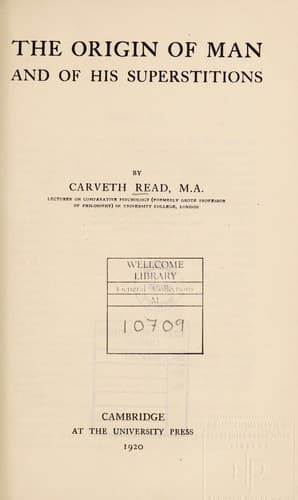
The Origin of Man and of His SuperstitionsRead, Carveth
Philosophy
The Origin of Man and of His Superstitions
Read, Carveth
Animism; Human beings -- Origin; Magic; Superstition; Totemism
Some Omens having been established by subjective prognostication or
by coincidence, many more may be added by analogy, or by a sort of
reasoning. An analogy with the contrast of right and left hand may
be noticed in all opposites: the woodpecker in Borneo, for example,
having two cries, and one of them a warning, must not the other
be an encouragement? The belief in Omens having taken hold of the
public mind, everybody is on the look-out for signs and wonders; and
anything unusual seen, or heard, or rumoured, becomes a possible
Omen of anything else, and men ask one another what it portends. The
superstitious imagination is greedy of its accustomed food. Under
such conditions, too, Omens are discovered by retrospection: a public
calamity, such as the death of a king, the defeat of an army, or a
pestilence (or in private life some private misfortune), makes us
remember some foregoing event or events, which must have forewarned
us, had we had the skill to interpret the significance of Time’s
progression.
§ 4. DIFFERENTIATION OF OMENS FROM GENERAL MAGIC
The savage mind, sensitive to the resemblance of relations, cannot
overlook the analogy between signs and warning cries; many Omens are
cries; and with the spread of animistic explanation, they came to
be considered as the sendings of spirits or gods. But, at first, by
mere magical thinking, under the stress of anxiety to know the future,
and the helplessness of common sense to predict anything outside
the everyday routine, Omens are gradually separated from ordinary
probable signs (such as the tracks of game) as necessary infallible
signs (or tendencies) if cunning can find them out, connected by some
supernatural law with the unknown future that certainly awaits us, and
as a kind of Magic. The magical habit of mind may be supposed to have
resulted from the coalescence of beliefs concerning several imaginary
operations—by charms, spells, rites—each class of beliefs having its
own occasions, causes, or fallacious grounds. Those operations had in
common the marks of being connexions of events due to imagined forces
of a mysterious kind, and therefore grouped themselves together in
men’s minds as the Magic apperception-mass. Omens had these marks and,
therefore, were assimilated to Magic. An Omen is an event regarded as
a magical sign of the good or ill success of some undertaking, or of
the approach of good fortune, or of calamity. And on the principle that
ideas are differentiated from a confused matrix, it is probable that
Omens, having at first been confused with other magical antecedents
of events, were only gradually again distinguished from them. But
an important distinction existed and at last came to light: charms,
rites and spells are causes of events; whereas Omens are signs only,
not causes. The difference is that whereas charms, rites and spells
directly exert their powers upon the course of things, Omens themselves
Public-domain text, read in full here on John Shaqi.
Reviews
Reviews
No reviews yet
Be the first to share your thoughts on this work.
Elsewhere in the archive
Join the Discussion
Join the discussion
Sign in to leave a comment or review.
Sign InorCreate an account