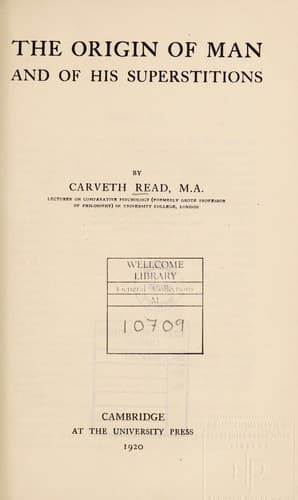
The Origin of Man and of His SuperstitionsRead, Carveth
Philosophy
The Origin of Man and of His Superstitions
Read, Carveth
Animism; Human beings -- Origin; Magic; Superstition; Totemism
Omens (as has been mentioned) resemble warnings: (_a_) Like warnings,
they precede events, but do not cause them. (_b_) They sometimes
precede an event by a considerable interval, as if to give time for
precaution. (_c_) They do not announce the details of any event (which
a friendly counsellor may not know), but only its character as good or
evil. Then, if they are warnings (implying foreknowledge), since they
are not the act of any man, they must be given by some spirit or other
intelligence. So that once a belief in the intervention of spirits in
mundane affairs has become prevalent in any tribe, nothing can be more
natural than to regard Omens as spiritual messages. Still, this way of
thinking may have been preceded by a disposition to attribute Omens
to the good will of animals, especially Totems; for animals are often
wiser than we are. In Australia the Turbal tribe held that the chirping
of insects foretold the coming of blacks; a Wakelbwa who dreamed of
a kangaroo would expect one of the Banbe subclass next day; to dream
of old-man kangaroos sitting round the fire presaged danger.[355]
Among the Yuin (Western Australia) a Black-Duck clansman thought that
black ducks warned him against enemies; and men of the Kurnai, who had
personal Totems, thought they gave protection by warnings.[356] Very
early, however, ghosts or spirits sometimes come themselves to instruct
us; as amongst the Kurnai, the Biraark (wizards) hold _séances_ at
night, when ghosts attend, and give news of enemies or of absent
friends.[357] In New Guinea, the ghosts of dead tribesmen send their
surviving relatives Omens by fishes or birds.[358]
By this animistic theory Omens are intimately connected with Oracles
and Dreams; for these, too, are messages from the spirit-world.
Dreams are the chief causes of belief in spirits, and with many people
have not yet lost the character of supernatural visitations. Probably
for ages past there have been in each generation a few rationalists,
who treated dreams in the manner of Artabanes (as reported by
Herodotus[359]—who, however, will show that the event refuted him),
holding that “whatever a man has been thinking of during the day
is wont to hover round him in the visions of his dreams at night.”
Incensed against the diviners, rationalists have, in fact, too much
despised and neglected dreams.
Public-domain text, read in full here on John Shaqi.
Reviews
Reviews
No reviews yet
Be the first to share your thoughts on this work.
Elsewhere in the archive
Join the Discussion
Join the discussion
Sign in to leave a comment or review.
Sign InorCreate an account