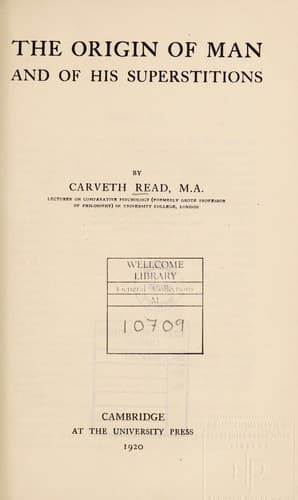
The Origin of Man and of His SuperstitionsRead, Carveth
Philosophy
The Origin of Man and of His Superstitions
Read, Carveth
Animism; Human beings -- Origin; Magic; Superstition; Totemism
the recognition of caprice and the belief in uniformity—since the
gods themselves work by Magic and may be subject to its powers. It is
not an antagonism of principle, but partly of allegiance and partly of
ambition.
The influence of wizards is generally extended by means of clubs and
secret societies: wizards form a marked class, are well aware of it,
and are naturally drawn into mutual understanding. In Australia no
regular societies seem to have existed, but the medicine-men recognised
one another, initiated and trained new-comers into the profession,
had an esoteric tradition of rites and methods and fictions, and
sometimes met for consultation. Among the savages of Torres Straits,
the _maidelaig_ meet together in the bush at night, in order to perform
their sorcery, and the body of sorcerers can control an individual
_maidelaig_; but they appear not to have a definitely organised
society.[399] In Melanesia, however, many regular societies exist;[400]
and among the Northern Amerinds they were numerous and powerful. The
Midewinian society of the Ojibways is typical of these institutions.
It was the club of the legitimate professionals, in contrast with
private practitioners, who were said (of course) to be favoured by evil
_manidos_. To join the society one must undergo instruction, paying
fees and making presents to its members. It comprised about one-tenth
of the tribe, and what with influence, what with perquisites, did very
well.[401] In Africa also such societies flourish.
Public-domain text, read in full here on John Shaqi.
Reviews
Reviews
No reviews yet
Be the first to share your thoughts on this work.
Elsewhere in the archive
Join the Discussion
Join the discussion
Sign in to leave a comment or review.
Sign InorCreate an account