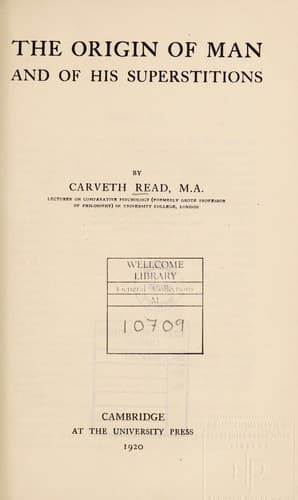
The Origin of Man and of His SuperstitionsRead, Carveth
Philosophy
The Origin of Man and of His Superstitions
Read, Carveth
Animism; Human beings -- Origin; Magic; Superstition; Totemism
The same compelling power was employed—if we may trust the
_Kalevala_—by Finnish wizards; for “every thing or being loses its
ability for evil, as soon as some one is found who knows, who proclaims
its essence, its origin, its genealogy.” “Tietaja, which etymologically
signifies wise, or learned, is ordinarily used for magician.”[423]
It was by profound science that mediæval magicians were believed to
control demons; and anybody celebrated for science was suspected of
sorcery: such as Grosseteste, Albertus Magnus, Roger Bacon, Aquinas,
and Raymond Lulli; whose reputation supported the credit of such men as
Paracelsus and John Dee.
The fine arts in their rudiments owe much to the wizards. Incantations
in verse often reach a high pitch of lyric fervour. The words _rune_,
_carmen_, _laulaa_ bear witness to the magic of poetry. Virgil and
Taliessin have been famous for more than natural gifts; that one by
superstitious repute, and this by his own vaunting.[424] Dancing and
pantomime were cultivated for their magical virtues. Primitive carving
and painting are in many cases undertaken in order to influence the
spirits, or the animals, or the natural powers they represent; and if
Magic was the motive of the recently discovered animal paintings dating
from the old Stone Age, its efficacy in encouraging art at that remote
period rivalled that of religious patronage in some later ages.
(2) In most tribes the wizard needs great force of will and persistency
of purpose—whether from deliberate choice or from infatuation with
the profession—to carry him through the severe training that is often
exacted from candidates for the office; great audacity and courage to
impel and sustain him in the practice of his art, pestered by taboos
and (the sorcerer especially) always beset by supernatural terrors and
often by more real dangers; and unusual presence of mind to extricate
himself from very embarrassing situations. It is true that, in some
cases, where the office of wizard is hereditary, or may be assumed by
alleging the favour of spirits, or some other underhand device—perhaps
upon the evidence of visions, or by mere fraud, or by a mixture of
both—we hear little of really serious initiatory rites; but often
these formalities are very painful or very expensive. Among the Arunta,
there are three classes of wizards: the first and second, made by
spirits, undergo no severe trial—except the boring of a hole in their
own tongues and the keeping of it open, as evidence of a professional
story about spirits who slew them with spears, cut out their entrails
and replaced them with a new set and certain magic stones. But the
third class are initiated by two wizards of the first and second
class, who pretend to force crystal stones[425] into their bleeding
bodies from the front of the leg up to the breast bone, into the crown
of their heads and under the nail of the right forefinger. This they
must suffer in perfect silence, three times a day on three consecutive
Public-domain text, read in full here on John Shaqi.
Reviews
Reviews
No reviews yet
Be the first to share your thoughts on this work.
Elsewhere in the archive
Join the Discussion
Join the discussion
Sign in to leave a comment or review.
Sign InorCreate an account