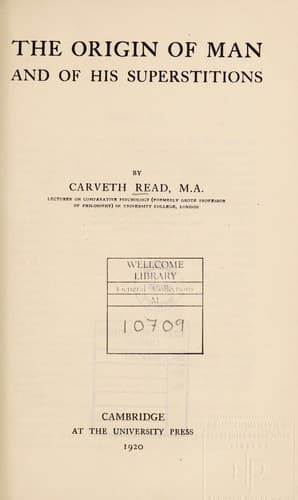
The Origin of Man and of His SuperstitionsRead, Carveth
Philosophy
The Origin of Man and of His Superstitions
Read, Carveth
Animism; Human beings -- Origin; Magic; Superstition; Totemism
Men of such a temperament, I take it, distinguishing themselves
above others when every man practised magic or sorcery, founded the
profession, and are always its vital nucleus, though in time they
may become but a small proportion of its members. Under sincere
infatuation they established its observances—the fastings, sufferings,
austerities, visions and frenzies of initiation, whether into magical
knowledge or spiritual possession; the working of themselves up,
whilst officiating, into the orgiastic intoxication in which they felt
their own greatness and dominated their audience; and they discovered
some of the modes of operating by drugs and suggestion and some real
remedies. But the profession, once formed, soon had attractions for
a very different sort of man, impelled by very different motives;
who saw in it the road sometimes to wealth, always to reputation and
power. Since, amongst very primitive people there is little wealth
to collect, and sometimes (as we have seen) remuneration of magical
services is neither given nor expected, the earlier of these motives
must have been the love of causing wonder and fear, of the power which
their fellows’ fears conferred and of the reputation which consequently
spread far and wide. In Mota (Melanesia) a man in control of magical
virtue will render services without reward, merely to add to his
reputation for the possession of _mana_.[445] At first they seem to
have had no privileges, but power acquires privilege: so that, among
the Warramunga, wizards are free from sexual taboos;[446] in Guiana no
tribesman dares refuse the sorcerer anything, not even his wife;[447]
among the Boloki, the sorcerer is never charged with injurious
witchcraft and, therefore, is never in danger of the ordeal.[448]
Sometimes, indeed, the wizard may not be respected in private life,
but only in the exercise of his office. Fear and wonder, in fact, do
not always entirely blind the eyes of neighbours to his shortcomings.
Spencer and Gillen tell us that the Magic of distant places, being
the less known, is the more feared.[449] The Rev. J. H. Weeks even
says that on the Congo the village medicine-man is seldom engaged at
home; for the people know that his fetich cannot protect him or his
from harm and, therefore, hire some one from another village of whom
they know less.[450] Similarly, a tribe is apt to fear its own adepts
less than those of another tribe of lower culture, whose ways are less
known and more mysterious: as Malays fear especially the Jakuns;[451]
formerly the Swedes the Finns, and the Finns the Lapps; the Todas the
Kurumba;[452] and in Macedonia Mohammedan monks enjoy a far higher
reputation for Magic than the Christian.[453]
Public-domain text, read in full here on John Shaqi.
Reviews
Reviews
No reviews yet
Be the first to share your thoughts on this work.
Elsewhere in the archive
Join the Discussion
Join the discussion
Sign in to leave a comment or review.
Sign InorCreate an account