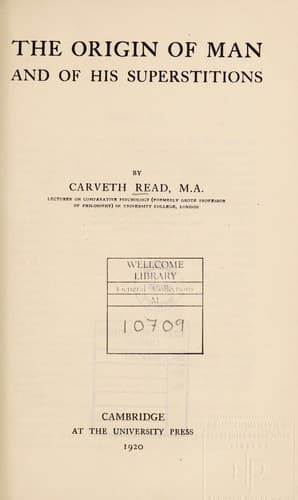
The Origin of Man and of His SuperstitionsRead, Carveth
Philosophy
The Origin of Man and of His Superstitions
Read, Carveth
Animism; Human beings -- Origin; Magic; Superstition; Totemism
Again, the general prevalence of delusions in a tribe does not
suppress the scepticism of individuals. It is reasonable to expect
such scepticism to be most prevalent amongst men of rank, who are
comparatively exempt from the oppression of popular sanctions; and
probably this is the fact. Such exemption, by preserving a nucleus
of relatively sane people, is one of the great social utilities of
rank. The Basuto chief, Mokatchané, surrounded by people grossly
superstitious, lent himself to their practices; but in paying his
diviners he did not hesitate so say “that he regarded them as the
biggest impostors in the world.”[474] In Fiji, it is doubtful whether
the high chiefs believed in the inspiration of the priests, though it
suited their policy to appear to do so. There was an understanding
between the two orders: one got sacrifices (food), the other good
oracles. A chieftain, on receiving an unfavourable oracle, said to
the priest: “Who are you? Who is your god? If you make a stir, I will
eat you”[475]—not metaphorically. In Tonga, “even seventeen years
before the arrival of the first missionaries, the chiefs did not
care to conceal their scepticism.” In Vavou, Taufaahan, having long
been sceptical of his ancestral faith, on learning of Christianity,
hanged five idols by the neck, beat the priestess, and burned the
spirit-houses.[476] The Vikings, like the Homeric heroes, are said
to have fought their gods; and at other times to have declared
entire disbelief in them. Hence the easy conversion of the North to
Christianity. Scepticism may have been fashionable at court much
earlier: “It is scarcely possible to doubt,” says Mr. Chadwick,
“that familiarity, not to say levity, in the treatment of the gods
characterised the Heroic Age [Teutonic—A.D. 350-550] just as much as
that of the Vikings.”[477] The burlesque representations of the gods
in some passages of the _Iliad_ are a sort of atheism: in astonishing
contrast with the sublime piety elsewhere expressed. And the inadequacy
of such a literary religion (like that of Valhalla) may explain the
facile reception (or revival) of the Mysteries in the sixth century
B.C. History abounds with examples of rulers and priests who, in
collusion, have used religion for political convenience, in a way that
implied their own disbelief and opened unintentionally the doors of
disbelief to others.
Public-domain text, read in full here on John Shaqi.
Reviews
Reviews
No reviews yet
Be the first to share your thoughts on this work.
Elsewhere in the archive
Join the Discussion
Join the discussion
Sign in to leave a comment or review.
Sign InorCreate an account