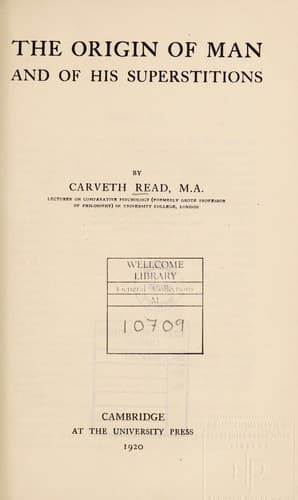
The Origin of Man and of His SuperstitionsRead, Carveth
Philosophy
The Origin of Man and of His Superstitions
Read, Carveth
Animism; Human beings -- Origin; Magic; Superstition; Totemism
In some very remote age—to summarise Lang’s statement—at a level of
culture inferior to that of existing Australians, distinctive names
were acquired by small groups of mankind. Since a group needs names
for other groups more than for itself (for itself it consists of
“men” as contrasted with other kinds of animals), names may at first
have been bestowed upon each group by some other, or others, in its
neighbourhood—probably names of animals or plants—and accepted by
each; for no opprobrium attaches to such names. In _Social Origins_
Lang offers evidence concerning names (even depreciatory and mocking
names) having been conferred in this way and accepted; but in _The
Secret of the Totem_,[526] he says that how groups got their names is
not essential to his theory. They may have been given, or adopted, on
account of a group’s staple food (Haddon); or because of some animal
or plant characteristic of a group’s territory; or for some fancied
resemblance of its members to some animal. The important point is
that, from the first, they were names of groups—not derived from the
names of individuals. At the early period assumed for these events
there was not a long enough memory of individuals to make their names
traditionary; and, indeed, the reckoning of descent in the female line
(which Lang regards as universally the most ancient custom) must have
prevented the inheritance of the names of male ancestors.
Whatever may have occasioned the first fixing of names, with the flight
of time the circumstances were forgotten; and groups of men and women
found themselves with names—the names of animals or plants—without
knowing why. The bearing of a name in common with an animal or plant
inevitably suggested to the savage a mysterious connexion with the
species—perhaps that they had the same sort of soul. It gave rise to
an explanatory myth, and the analogy of family relationship suggested
a blood-bond: the animal or plant must be one’s ancestor, brother, or
primal ancestral form. From this idea follows a regard for it, respect,
reverence: it must not be killed, or eaten, or used in any way; it may
be protected, may be helpful; it is a Totem.
Public-domain text, read in full here on John Shaqi.
Reviews
Reviews
No reviews yet
Be the first to share your thoughts on this work.
Elsewhere in the archive
Join the Discussion
Join the discussion
Sign in to leave a comment or review.
Sign InorCreate an account