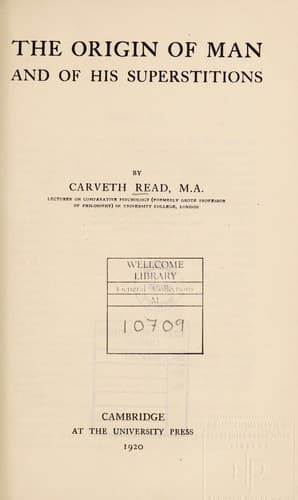
The Origin of Man and of His SuperstitionsRead, Carveth
Philosophy
The Origin of Man and of His Superstitions
Read, Carveth
Animism; Human beings -- Origin; Magic; Superstition; Totemism
Generally men and women of the same Totem cannot marry. Tribes, such
as the Arunta, that do not observe this rule are so few that it
is reasonable to consider them aberrant; so that in each case the
non-coincidence of Totemism and Exogamy is a distinct problem.
Nevertheless, there is reason to think that these institutions have not
the same origin. For several primitive tribes, some of them inferior
in culture to the average Australian, have customs of Exogamy, or
(at least) forbidding marriage between individuals of some certain
description, who have not, and are not known ever to have recognised
Totemism. Many tribes, again, who by their ethnological position may
be supposed once to have entertained Totemism, have abandoned it, but
still maintain Exogamy by means of Marriage-classes (phratries) or
otherwise. Further, many nations of advanced culture cannot be shown
ever to have been totemists, but have always (as far back as can be
traced) enforced Exogamy so far as to prohibit marriage within certain
degrees of kindred. And that the connexion between Totemism and Exogamy
is not original but acquired, is indicated by the consideration that
the most obvious tendency of Totemism would be to favour Endogamy
(the practice of not marrying outside certain limits), on the obvious
principle that as an animal kangaroo mates with an animal kangaroo, so
a human kangaroo should marry a human kangaroo. This is so obvious
that the opposite rule that a human kangaroo must not marry another
one, but (zoological paradox!) only an emu or a witchety-grub,
seems perverse, and only to be explained by the influence of some
superstition or incidental custom. According to Arunta tradition, their
ancestors in the Alcheringa were endogamous.
Whether Exogamy originated in the days of the hunting-pack—which
is so far probable that the Boschmans observed it—or during the
reconstitution of society after the breaking up of the packs, or even
later, or in some regions at one period, in others at another, is, I
fear, beyond our power of verifiable guessing. The best hypothesis as
to the grounds of the custom is Westermarck’s, namely, that an instinct
of mutual avoidance grew up between near kin. This requires that at
the time of its origination promiscuity of sexual relations should not
have prevailed in the human stock, since that would have destroyed the
conditions necessary to the rise of such an instinct. If promiscuity
was ever widely practised, it must have been after the breaking up of
the hunting-packs. That at some stage of human life, and apparently
with some Australian tribes not a remote one, promiscuity was
established, has been argued (on the ground of some Australian customs)
with much plausibility; but in his _History of Human Marriage_,[529]
Westermarck has examined this opinion very carefully, and concludes
that it is not tenable. His reasoning seems to me good throughout; and,
having nothing important to add to it, I refer the reader to his work.
Public-domain text, read in full here on John Shaqi.
Reviews
Reviews
No reviews yet
Be the first to share your thoughts on this work.
Elsewhere in the archive
Join the Discussion
Join the discussion
Sign in to leave a comment or review.
Sign InorCreate an account