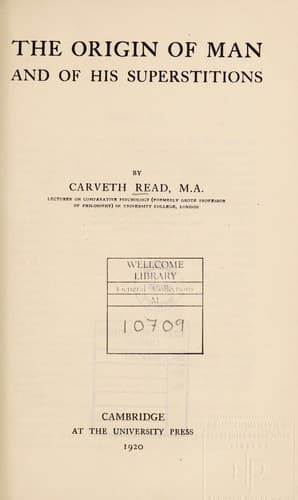
The Origin of Man and of His SuperstitionsRead, Carveth
Philosophy
The Origin of Man and of His Superstitions
Read, Carveth
Animism; Human beings -- Origin; Magic; Superstition; Totemism
Some exceptions to the rule that Totem-clans are exogamous may,
perhaps, be explained by supposing that certain bands had not adopted
Exogamy when they became totemists—may not this have happened amongst
the Arunta?—and that they have since learnt Exogamy under other
conditions from neighbouring people, or by conquest. Amongst the
other possible conditions there are the remarkable Marriage-classes,
or phratries that prevail in Australia, North America, and less
regularly in other parts of the world. These Marriage-classes are
considered by some ethnologists to be of deliberate institution—a
reform for the regulation of Exogamy; and Spencer and Gillen, who
knew the Australians so intimately, thought such a law—though its
intricacy astonishes most Europeans and stumbles many—was not beyond
their power of excogitation. Upon that point it would be absurd of me
to have any opinion. But to suppose deliberate intention is contrary
to the usual method of interpreting savage institutions: a savage
language is a system of customs much more intricate and refined than
the Marriage-classes, and not generally believed to have originated
with the deliberate enactment of rules of grammar. I conjecture
that those classes resulted at first from a grouping of exogamous
Totem-clans which grew up by custom, and that the only deliberate work
consisted in some minor adjustments of clan-relations. Marriage of
cousins is prevented in Central and North Australia by the recognition
of eight sub-classes; but the same result is obtained in other tribes
by a custom which merely forbids it. Exogamous classes having been
established in some tribes, may have been imitated in others.
One result of the classificatory marriage system, however it grew up,
is the extended use of names of kinship to denote all individuals of
the same or corresponding generation—“father” for all men who might
by custom have married your mother; “brother” and “sister” for all men
and women descended from those whom your father or mother might have
married; “husband” or “wife” for any man or woman whom, according to
custom, you might have married. When further progress has been made
in culture, distinctive names are used to express blood-relationship
and class-relationship. It may be worth considering whether, in
Australia, some of the customs which have been supposed to bear witness
to an original state of promiscuity are not really results of the
classificatory system of naming relationship: marital rights having
been claimed on the ground of the names “husband” and “wife” as used
in that system.
§ 6. THE CLANSMAN AND HIS TOTEM
Public-domain text, read in full here on John Shaqi.
Reviews
Reviews
No reviews yet
Be the first to share your thoughts on this work.
Elsewhere in the archive
Join the Discussion
Join the discussion
Sign in to leave a comment or review.
Sign InorCreate an account