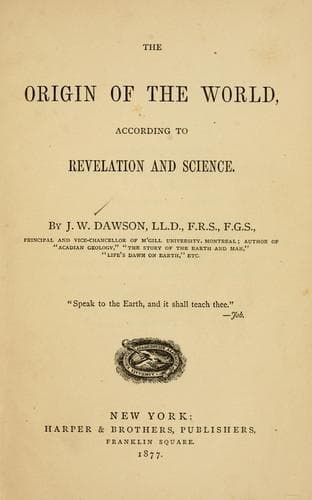
The Origin of the World According to Revelation and ScienceDawson, John William, Sir
Religion
The Origin of the World According to Revelation and Science
Dawson, John William, Sir
Bible and science; Religion and science
The ancient mythology of Persia appears to have had six creative
periods, each apparently of a thousand years, and corresponding very
nearly with the Mosaic days.[58] The Chaldeans had a similar system,
to which in a previous chapter we have already referred. The Etruscans
possessed a history of the creation, somewhat resembling that of the
Bible, and representing the creation as occupying six periods of a
thousand years each.[59]
The Egyptians believed that the world had been subject to a series of
destructions and renewals, the intervals between which amounted to
120,000 years, or, according to other authorities, to 300,000 or
360,000 years. This system of destruction and renewal the Egyptian
priests appear to have wrought out into considerable detail, but
though important truths may be concealed under their mysterious
dogmas, it will not repay us to dwell on the fragments that remain of
them. There can be no doubt, however, that at least the basis of the
Egyptian cosmogony must have been the common property of all the
Hamite nations, of which Egypt was the greatest and most permanent;
and therefore in all probability derived from the ideas of creation
which were current not long after the Deluge. The Egyptians appear
also, as already stated, to have had a physical cosmogony, beginning
with a chaos in which heaven and earth were mingled, and from which
were evolved fiery matters which ascended into the heavens, and moist
earthy matters which formed the earth and the sea; and from these were
produced, by the agency of solar heat, the various animals. The terms
of this cosmogony, as it is given by Diodorus Siculus, indicate the
belief of long formative periods.[60]
The Hindoos have a somewhat extended, though, according to the
translations, a not very intelligible cosmogony. It plainly, however,
asserts long periods of creative work, and is interesting as an
ancient cosmogony preserved entire and without transmission through
secondary channels. The following is a summary, in so far as I have
been able to gather it, from the translation of the Institutes of Menu
by Sir W. Jones.[61]
The introduction to the Institutes represents Menu as questioned by
the "divine sages" respecting the laws that should regulate all
classes or castes. He proceeds to detail the course of creation,
stating that the "Self-existing Power,[62] undiscovered, but making
this world discernible, He whom the mind alone can perceive, whose
essence eludes the external senses, who has no visible parts, who
exists from eternity, even the soul of all being, whom no being can
comprehend, shone forth in person."
Public-domain text, read in full here on John Shaqi.
Reviews
Reviews
No reviews yet
Be the first to share your thoughts on this work.
Elsewhere in the archive
Join the Discussion
Join the discussion
Sign in to leave a comment or review.
Sign InorCreate an account