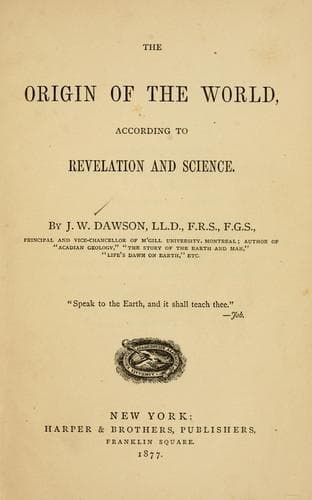
The Origin of the World According to Revelation and ScienceDawson, John William, Sir
Religion
The Origin of the World According to Revelation and Science
Dawson, John William, Sir
Bible and science; Religion and science
"Stand still and consider the wonderful works of God.
Dost thou know when God disposes them,
And the lightning of his cloud shines forth?
Dost thou know the poising of the dark clouds,
The wonderful works of the Perfect in knowledge?"
We may now consider the words in which this great improvement in the
condition of the earth is recorded. The Hebrew term for the atmosphere
is _Rakiah_, literally, something expanded or beaten out--an expanse.
It is rendered in our version "firmament," a word conveying the notion
of support and fixity, and in the Septuagint "_Stereoma_," a word
having a similar meaning. The idea conveyed by the Hebrew word is not,
however, that of _strength_, but of _extent_; or as Milton--the most
accurate of expositors of these words--has it:
"The firmament, expanse of liquid, pure,
Transparent, elemental air, diffused
In circuit to the uttermost convex
Of this great round."
That this was really the way in which this word was understood by the
Hebrews appears from several passages of the Bible. Job says of God,
"Who alone _spreadeth_ out the heavens."[71] David, in the 104th
Psalm, which is a poetical paraphrase of the history of creation,
speaks of the Creator as "_stretching_ out the heavens as a curtain."
In later writers, as Isaiah, Jeremiah, Ezekiel, similar expressions
occur. The notion of a solid or arched firmament was probably
altogether remote from the minds of these writers. Such beliefs may
have prevailed at the time when the Septuagint translation was made,
but I have no hesitation in affirming that no trace of them can be
found in the Old Testament. In proof of this, I may refer to some of
the passages which have been cited as affording the strongest
instances of this kind of "accommodation." In Exodus xxiv., 10, we
are told, "And they saw the God of Israel, and under his feet as it
were a paved work of sapphire, and as it were the heaven itself in its
clearness." This is evidently a comparison of the pavement seen under
the feet of Jehovah to a sapphire in its color, and to the heavens in
its transparency. The intention of the writer is not to give
information respecting the heavens, or to liken them either to a
pavement or a sapphire; all that we can infer is that he believed the
heavens to be clear or transparent. Job mentions the "pillars of
heaven," but the connection shows that this is merely a poetical
expression for lofty mountains. The earthquake causes these pillars of
heaven to "tremble." We are informed in the book of Job that God "ties
up his waters in his thick cloud, and the cloud is not rent under
them." We are also told of the "treasures of snow and the treasures of
hail," and rain is called the "bottles of heaven," and is said to be
poured out of the "lattices of heaven." I recognize in all these mere
poetical figures, not intended to be literally understood. Some
learned writers wish us to believe that the intention of the Bible in
Public-domain text, read in full here on John Shaqi.
Reviews
Reviews
No reviews yet
Be the first to share your thoughts on this work.
Elsewhere in the archive
Join the Discussion
Join the discussion
Sign in to leave a comment or review.
Sign InorCreate an account