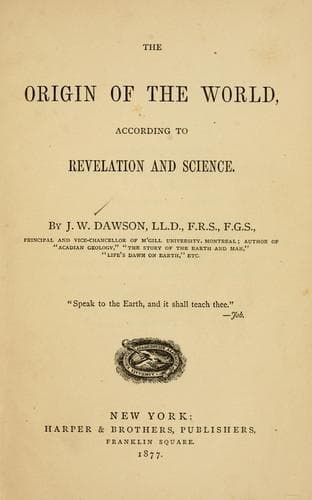
The Origin of the World According to Revelation and ScienceDawson, John William, Sir
Religion
The Origin of the World According to Revelation and Science
Dawson, John William, Sir
Bible and science; Religion and science
The waters here are those above the firmament, the whole of this part
of the Psalm being occupied with the heavens; and there is no place
left for the solid firmament, of which the writer evidently knew
nothing. He represents God as laying his chambers on the waters,
instead of on the supposed firmament, and as careering in cloudy
chariots on the wings of the wind, instead of over a solid arch. For
all the above reasons, we conclude that the "expanse" of the verses
under consideration was understood by the writers of the book of God
to be _aerial_, not _solid_; and the "establishment of the clouds
above," as it is finely called in Proverbs, is the effect of those
meteorological laws to which I have already referred, and which were
now for the first time brought into operation by the divine
Legislator. The Hebrew theology was not of a kind to require such
expedients as that of solid heavenly arches; it recurred at once to
the will--the decree--of Jehovah; and was content to believe that
through this efficient cause the "rivers run into the sea, yet the sea
is not full," for "to the place whence the rivers came, thither they
return again," through the agency of those floating clouds, "the
waters above the heavens," which "pour down rain according to the
vapor thereof."
God called the expanse "Heaven." In former chapters we have noticed
that heaven in the popular speech of the Hebrews, as in our own, had
different meanings, applying alike to the cloudy, the astral, and the
spiritual heavens. The Creator here sanctions its application to the
aerial expanse; and accordingly throughout the Scriptures it is used
in this way; _rakiah_ occurs very rarely, as if it had become nearly
obsolete, or was perhaps regarded as a merely technical or descriptive
term. The divine sanction for the use of the term heaven for the
atmosphere is, as already explained, to indicate that this popular
use is not to interfere with its application to the whole universe
beyond our earth in verse 1st.
The poetical parts of the Bible, and especially the book of Job, which
is probably the most ancient of the whole, abound in references to the
atmosphere and its phenomena. I may quote a few of these passages, to
enable us to understand the views of these subjects given in the
Bible, and the meaning attached to the creation of the atmosphere, in
very ancient periods. In Job, 38th chapter, we have the following:
"In what way is the lightning distributed,
And how is the east wind spread abroad over the earth?
Who hath opened a channel for the pouring rain,
Or a way for the thunder-flash?
To cause it to rain on the land where no man is,
In the desert where no one dwells;
To saturate the desolate and waste ground,
And to cause the bud of the tender herb to spring forth."
Public-domain text, read in full here on John Shaqi.
Reviews
Reviews
No reviews yet
Be the first to share your thoughts on this work.
Elsewhere in the archive
Join the Discussion
Join the discussion
Sign in to leave a comment or review.
Sign InorCreate an account