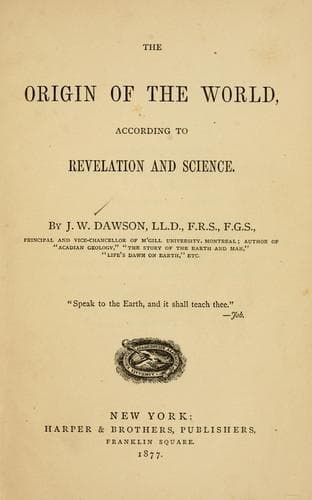
The Origin of the World According to Revelation and ScienceDawson, John William, Sir
Religion
The Origin of the World According to Revelation and Science
Dawson, John William, Sir
Bible and science; Religion and science
may still have produced an effect in warming the oceanic waters. The
combined operation of these causes, of which we, perhaps, have some
traces as late as the Carboniferous period, might well produce a state
of things in which the earth was watered, not by showers of rain, but
by the gentle and continued precipitation of finely divided moisture,
in the manner now observed in those climates in which vegetation is
nourished for a considerable part of the year by nocturnal mists and
copious dews. The atmosphere, in short, as yet partook in some slight
degree of the same moist and misty character which prevailed before
the "establishment of the clouds above"--the airy firmament of the
second day. The introduction of these explanatory particulars by the
sacred historian furnishes an additional argument for the theory of
long periods. That vegetation should exist for two or three natural
days without rain or the irrigation which is given in culture, was, as
already stated, a circumstance altogether unworthy of notice; but the
growth during a long period of a varied and highly organized flora,
without this advantage, and by the aid of a special natural provision
afterward discontinued, was in all respects so remarkable and so
highly illustrative of the expedients of the divine wisdom that it
deserved a prominent place.
It is evident that the words of the inspired writer include plants
belonging to all the great subdivisions of the vegetable kingdom. This
earliest vegetation was not rude or incomplete, or restricted to the
lower forms of life. It was not even, like that of the coal period,
solely or mainly cryptogamous or gymnospermous. It included trees
bearing fruit, as well as lichens and mosses, and it received the same
stamp of approbation bestowed on other portions of the work--"it was
good." We have a good right to assume that its excellence had
reference not only to its own period, but to subsequent conditions of
the earth. Vegetation is the great assimilating power, the converter
of inorganic into organic matter suitable for the sustenance of
animals. In like manner the lower tribes of plants prepare the way for
the higher. We should therefore have expected _a priori_ that
vegetation would have clothed the earth before the creation of
animals, and a sufficient time before it to allow soils to be
accumulated, and surplus stores of organic matter to be prepared in
advance: this consideration alone would also induce us to assign a
considerable duration to the third day. After the elevation of land,
and the draining off from it of the saline matter with which it would
be saturated, a process often very tedious, especially in low tracts
of ground, the soil would still consist only of mineral matter, and
must have been for a long period occupied by plants suited to this
condition of things, in order that sufficient organic matter might be
accumulated for the growth of a more varied vegetation; a
Public-domain text, read in full here on John Shaqi.
Reviews
Reviews
No reviews yet
Be the first to share your thoughts on this work.
Elsewhere in the archive
Join the Discussion
Join the discussion
Sign in to leave a comment or review.
Sign InorCreate an account