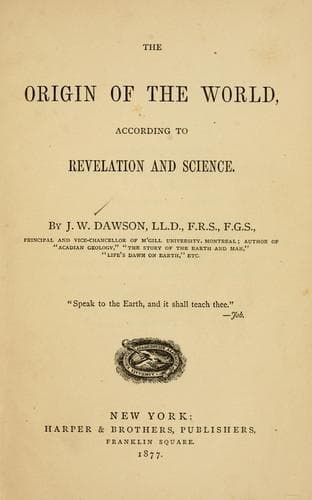
The Origin of the World According to Revelation and ScienceDawson, John William, Sir
Religion
The Origin of the World According to Revelation and Science
Dawson, John William, Sir
Bible and science; Religion and science
--Job xxxviii., 31.
I may merely remark on these passages that the chambers of the south
are supposed to be those parts of the southern heavens invisible in
the latitude in which Job resided. The bonds of Pleiades and of Orion
probably refer to the apparently close union of the stars of the
former group, and the wide separation of those of the latter; a
difference which, to the thoughtful observer of the heavens, is more
striking than most instances of that irregular grouping of the stars
which still forms a question in astronomy, from the uncertainty
whether it is real, or only an optical deception arising from stars at
different distances coming nearly into a line with each other. I have
seen in some recent astronomical work this very instance of the
Pleiades and Orion taken as a marked illustration of this
problematical fact in astronomy. _Mazzaroth_ are supposed by modern
expositors to be the signs of the Zodiac.
On the whole, the Hebrew books give us little information as to the
astronomical theories of the time when they were written. They are
entirely non-committal as to the nature of the connections and
revolutions of the heavenly bodies; and indeed regard these as matters
in their time beyond the grasp of the human mind, though well known to
the Creator and regulated by his laws. From other sources we have
facts leading to the belief that even in the time of Moses, and
certainly in that of the later Biblical writers, there was not a
little practical astronomy in the East, and some good theory. The
Hindoo astronomy professes to have observations from 3000 B.C., and
the arguments of Baily and others, founded on internal evidence, give
some color of truth to the claim. The Chaldeans at a very early period
had ascertained the principal circles of the sphere, the position of
the poles, and the nature of the apparent motions of the heavens as
the results of revolution on an inclined axis. The Egyptian astronomy
we know mainly from what the Greeks borrowed from it. Thales, 640
B.C., taught that the moon is lighted by the sun, and that the earth
is spherical, and the position of its five zones. Pythagoras, 580
B.C., knew, in addition to the sphericity of the earth, the obliquity
of the ecliptic, the identity of the evening and morning star, and
that the earth revolves round the sun. This Greek astronomy appears
immediately after the opening of Egypt to the Greeks; and both these
philosophers studied in that country. Such knowledge, and more of the
same character, may therefore have existed in Egypt at a much earlier
period.
The Psalms abound in beautiful references to the creation of the
fourth day:
"When I consider the heavens, the work of thy fingers,
The moon and the stars, which thou hast ordained;
What is man, that thou art mindful of him?
Or the son of man, that thou visitest him?"
--Psalm viii.
Public-domain text, read in full here on John Shaqi.
Reviews
Reviews
No reviews yet
Be the first to share your thoughts on this work.
Elsewhere in the archive
Join the Discussion
Join the discussion
Sign in to leave a comment or review.
Sign InorCreate an account