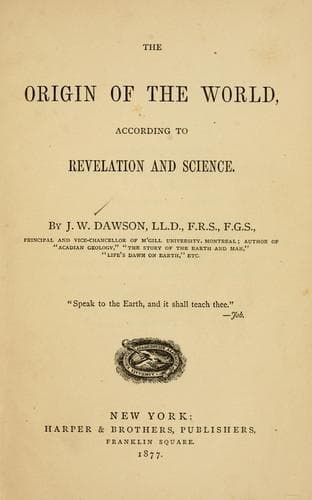
The Origin of the World According to Revelation and ScienceDawson, John William, Sir
Religion
The Origin of the World According to Revelation and Science
Dawson, John William, Sir
Bible and science; Religion and science
The creation of the sixth day therefore includes--1st, the herbivorous
mammalia; 2d, a variety of terrestrial reptilia, and other lower forms
not included in the work of the previous day; 3d, the carnivorous
mammalia. It will be observed that the order in the two verses is
different. In verse 24th it is herbivora, "creeping things," and
carnivora. In verse 25th it is carnivora, herbivora, and "creeping
things." One of these may, as in the account of the fifth day,
indicate the order of _time_ in the creation, and the other the order
of _rank_ in the animals made, or there may have been two divisions of
the work, in the earlier of which herbivorous animals took the lead,
and in the later those that are carnivorous. In either case we may
infer that the herbivora predominated in the earlier creations of the
period.
It is almost unnecessary to say this period corresponds with the
Tertiary or Cainozoic era of geologists. The coincidences are very
marked and striking. As already stated, though in the later secondary
period there were great facilities for the preservation of mammals in
the strata then being deposited, only a few small species of the
humblest order have been found; and the occurrence of the higher
orders of this class is to some extent precluded by the fact that the
place in nature now occupied by the mammals was then provided for by
the vast development of the reptile tribes. At the very beginning of
the tertiary period all this was changed; most of the gigantic
reptiles had disappeared, and terrestrial mammals of large size and
high organization had taken their place. Perhaps no geological change
is more striking and remarkable than the sudden disappearance of the
reptilian fauna at the close of the mesozoic, and the equally abrupt
appearance of numerous species of large mammals, and this not in one
region only, but over both the great continents, and not only where a
sudden break occurs in the series of formations, but also where, as in
Western America, they pass gradually into each other. During the whole
tertiary period this predominance of the mammalia continued; and as
the mesozoic was the period of giant reptiles, so the tertiary was
that of great mammals. It is a singular and perhaps not accidental
coincidence that so many of the early tertiary mammals known to us are
large herbivora, such as would be included in the Hebrew word
_bhemah_; and that in the book of Job the hippopotamus is called
_behemoth_, the plural form being apparently used to denote that this
animal is the chief of the creatures known under the general term
_bhemah_, while geology informs us that the prevailing order of
mammals in the older tertiary period was that of the ungulates, and
that many of the extinct creatures of this group are very closely
allied to the hippopotamus. Behemoth thus figures in the book of Job,
not only as at the time a marked illustration of creative power, but
to our farther knowledge also as a singular remnant of an extinct
Public-domain text, read in full here on John Shaqi.
Reviews
Reviews
No reviews yet
Be the first to share your thoughts on this work.
Elsewhere in the archive
Join the Discussion
Join the discussion
Sign in to leave a comment or review.
Sign InorCreate an account