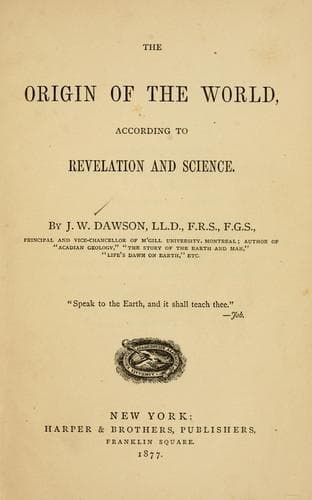
The Origin of the World According to Revelation and ScienceDawson, John William, Sir
Religion
The Origin of the World According to Revelation and Science
Dawson, John William, Sir
Bible and science; Religion and science
Art takes her true place when she sits at the feet of nature, and
brings her students to drink in its beauties, that they may endeavor,
however imperfectly, to reproduce them. On the other hand, the student
of nature must not content himself with "writing Latin names on white
paper," wherewith to label nature's productions, but must rise to the
contemplation of the order and beauty of the Cosmos as a revelation of
Divinity. Both will thus rise to that highest taste which will enable
them to appreciate not only the elegance of individual forms, but
their structure, their harmonies, their grouping and their relations,
their special adaptation, and their places as parts of a great system.
Thus art will attain that highest point in which it displays original
genius, without violating natural truth and unity, and nature will be
regarded as the highest art.
Much is said and done in our time with reference to the cultivation of
popular taste for fine art as a means of civilization; and this, so
far as it goes, is well; but the only sure path to the highest
taste-education is the cultivation of the study of nature. This is
also an easier branch of education, provided the instructors have
sufficient knowledge. Good works of art are rare and costly; but good
works of nature are everywhere around us, waiting to be examined. Such
education, popularly diffused, would react on the efforts of art. It
would enable a widely extended public to appreciate real excellence,
and would cause works of art to be valued just in proportion to the
extent to which they realize or deviate from natural truth and unity.
I do not profess to speak authoritatively on such subjects, but I
confess that the strong impression on my mind is that neither the
revered antique models, nor the practice and principles of the
generality of modern art reformers, would endure such criticism; and
that if we could combine popular enthusiasm for art with scientific
appreciation of nature, a new and better art might arise from the
union.
Public-domain text, read in full here on John Shaqi.
Reviews
Reviews
No reviews yet
Be the first to share your thoughts on this work.
Elsewhere in the archive
Join the Discussion
Join the discussion
Sign in to leave a comment or review.
Sign InorCreate an account