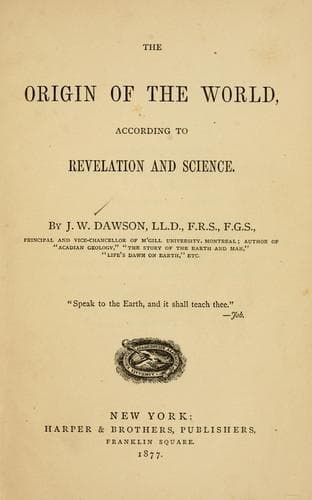
The Origin of the World According to Revelation and ScienceDawson, John William, Sir
Religion
The Origin of the World According to Revelation and Science
Dawson, John William, Sir
Bible and science; Religion and science
The Bible knows but one species of man. It is not said that men were
created after their species, as we read of the groups of animals. Man
was made, "male and female;" and in the fuller details afterwards
given in the second chapter--where the writer, having finished his
general narrative, commences his special history of man--but one
primitive pair is introduced to our notice. We scarcely need the
detailed tables of affiliation afterward given, or the declaration of
the apostle who preached to the supposed autochthones of Athens, that
"God has made of one blood all nations," to assure us of the
Scriptural unity of man. If, therefore, there were any good reason to
believe that man is not of one but several origins, we must admit
Moses to have been very imperfectly informed. Nor, on the other hand,
does the Bible any more than geology allow us to assign a very high
antiquity to the origin of man relatively to that of the earth on
which he dwells. The genealogical tables of the Bible may admit of
some limits of difference of opinion as to the age of the human world
or aeon, and also of that of the deluge, from which man took his second
point of departure; but they do not allow us to put the origin of man
farther back than that of the present or modern condition of our
continents and the present races of animals. They therefore limit us
to the modern or quaternary period of geology. The question of man's
antiquity, so much agitated now, demands, however, a separate and
careful consideration; but we must first devote a few pages to the
simple statements of the Bible respecting the Sabbath of creation and
its relation to human history.
CHAPTER XII.
THE REST OF THE CREATOR.
"And the heavens and the earth were finished, and all the
host of them. And on the seventh day God ended his work
which he had made, and he rested on the seventh day from all
his work which he had made. And God blessed the seventh day
and sanctified it, because that in it God rested from all
his work which he had created to make."--Genesis ii., 1-3.
The end of the sixth day closed the work of creation properly so
called, as well as that of forming and arranging the things created.
The beginning of the seventh introduced a period which, according to
the views already stated, was to be occupied by the continued increase
and diffusion of man and the creatures under his dominion, and by the
gradual disappearance of tribes of creatures unconnected with his
well-being.
Public-domain text, read in full here on John Shaqi.
Reviews
Reviews
No reviews yet
Be the first to share your thoughts on this work.
Elsewhere in the archive
Join the Discussion
Join the discussion
Sign in to leave a comment or review.
Sign InorCreate an account