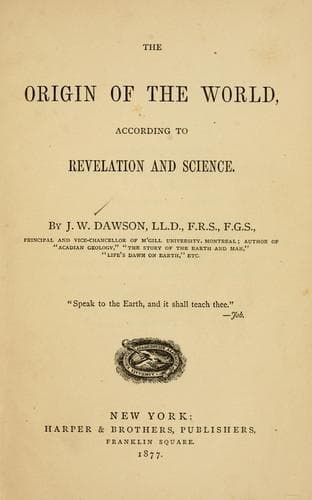
The Origin of the World According to Revelation and ScienceDawson, John William, Sir
Religion
The Origin of the World According to Revelation and Science
Dawson, John William, Sir
Bible and science; Religion and science
1. Adam and Isha, the woman, afterward called Eve (Life-giver), in
consequence of the promise of a Redeemer, commenced a life of
husbandry on their expulsion from Eden, which, on the ordinary views
of the Bible chronology, may be supposed to have occurred from 4000 to
5000 years before the Christian era; and during the lifetime of the
primal pair, the sheep, at least, was domesticated. The Bible, of
course, knows nothing of the imaginary continent of Lemuria, in which,
according to some hypotheses, men are supposed to have had their birth
from apes. A few generations after, in the time of Lamech, cattle were
domesticated; and the metals copper and iron were applied to use--the
latter probably meteoric iron; and hence, it may be, the Hindoo and
Hellenic myths of Twachtrei and Hephaestos in connection with the
thunderbolt. We learn, however, incidentally, as already mentioned, in
the description of Eden in Genesis, chapter 2d, that there was a
previous stone age, in which "flint, pearls or shell beads, and
stream-gold" were the chief treasures of man, for this is implied in
the "gold, bedolach, and onyx" of the land of Havilah. It is certain
also, from the discoveries made in Assyria, on the site of Troy, and
elsewhere, that the use of stone implements continued in Western Asia
long after the deluge. In the time of Noah the distinction of clean
and unclean beasts, and the taking of seven pairs of certain beasts
and birds into the ark, imply that certain mammals and birds were
domesticated.[108]
2. Before the flood, as already remarked, there was a division of man
into two nationalities or races; and there was a citizen, an
agricultural, a pastoral, and a nomadic population. Farther, the
remarkable progress in the arts implied in the building of such
structures as the Tower of Babel, and other temple and palace mounds
in Assyria, and of the pyramids of Egypt, within a few generations
after the deluge, proves that a very advanced material civilization
and great skill in constructive arts had been reached in antediluvian
times.[109]
Public-domain text, read in full here on John Shaqi.
Reviews
Reviews
No reviews yet
Be the first to share your thoughts on this work.
Elsewhere in the archive
Join the Discussion
Join the discussion
Sign in to leave a comment or review.
Sign InorCreate an account