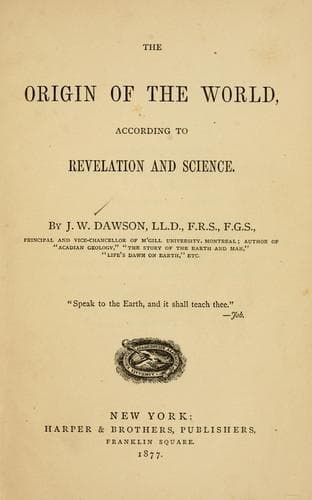
The Origin of the World According to Revelation and ScienceDawson, John William, Sir
Religion
The Origin of the World According to Revelation and Science
Dawson, John William, Sir
Bible and science; Religion and science
Even in the present day, Moffat informs us that in South Africa the
separation of parts of a tribe, for even a few months, may produce a
notable difference of dialect. If we take the existing languages of
civilized men whose history is known, we shall find that it is
impossible to trace many of them back as far as the Christian era, and
when we have passed over even half that interval, they become so
different as to be unintelligible to those who now speak them. Where
there are exceptions to this, they arise entirely from the effects of
literature and artificial culture. While, therefore, there is good
ground in philology for the belief in one primitive language, there
seems no absolute necessity to have recourse even to the confusion of
tongues at Babel to explain the diversities of language.[132] Farther,
the Bible carries back the Semitic group of languages at least to the
time of the Deluge, but it does not seem necessary on the mere ground
of antediluvian names, to carry it any farther back, and the Assyrian
inscriptions show the coexistence of Turanian and Semitic tongues at
the dawn of history in the region of the Euphrates and Tigris. One or
other of these--or a monosyllabic language underlying it--was probably
an antediluvian tongue, and the other a very early derivative; and
both history and philology would assign the precedence to the Turanian
language, which was probably most akin to that which had descended
from antediluvian times, and which at that early period of dispersion
indicated in the Bible story of Babel, had begun to throw off its two
great branches of the Aryan and Semitic languages. These, proceeding
in two dissimilar lines of development, continue to exist to this day
along with the surviving portions of the uncultivated Turanian speech.
To this point, however, we may return under another head.
CHAPTER XIV.
UNITY AND ANTIQUITY OF MAN--(_Continued._)
"By the word of God the heavens were from of old, and the
earth, formed out of water, and by means of water, by which
waters the world that then was, being overflowed with water,
perished."--2 Peter iii., 5, 6.
Public-domain text, read in full here on John Shaqi.
Reviews
Reviews
No reviews yet
Be the first to share your thoughts on this work.
Elsewhere in the archive
Join the Discussion
Join the discussion
Sign in to leave a comment or review.
Sign InorCreate an account