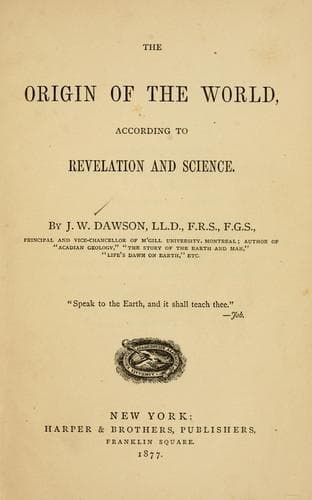
The Origin of the World According to Revelation and ScienceDawson, John William, Sir
Religion
The Origin of the World According to Revelation and Science
Dawson, John William, Sir
Bible and science; Religion and science
Pictet says, in the introduction to his "Traite de Paleontologie:" "It
seems to me impossible that we should admit, as an explanation of the
phenomena of successive faunas, the passage of species into one
another; the limits of such transitions of species, even supposing
that the lapse of a vast period of time may have given them a
character of reality much greater than that which the study of
existing nature leads us to suppose, are still infinitely within those
differences which distinguish two successive faunas. Lastly, we can
least of all account by this theory for the appearance of new _types_,
to explain the introduction of which we must necessarily, in the
present state of science, recur to the idea of distinct creations
posterior to the first."
The following are the general conclusions of Bronn, in his elaborate
and most valuable essay, presented to the French Academy in 1856, as
summarized in a notice of the work in the Journal of the Geological
Society:
"1. The first productions of this power in the oldest Neptunian strata
of the earth consisted of Plants, Zoophytes, Mollusks, Crustaceans,
and perhaps even Fish; the simultaneous appearance of which,
therefore, contradicts the assumption that the more perfect organic
forms arose out of the gradual transformation in time of the more
imperfect forms.
"2. The same power which produced the first organic forms has
continued to operate in intensively as well as extensively increasing
activity during the whole subsequent geological period, up to the
final appearance of man; but here also can no traces be found of a
gradual transformation of old species and genera into new; but the new
have everywhere appeared as new without the co-operation of the
former.
"3. In the succession of the different forms of plants and animals, a
certain regular course and plan is perceptible, which is quite
independent of chance. While all species possess only a limited
duration, and must sooner or later disappear, they make way for
subsequent new ones, which not only almost always offer an equivalent,
in number, organization, and duties to be performed, for those which
have disappeared, but which are also generally more varied, and
therefore more perfect, and always maintain an equilibrium with each
other in their stage of organization, their mode of life, and
functions. There always exists, therefore, a certain fixed relation
between the newly arising and the disappearing forms of organic life.
"4. A similar relation necessarily exists between the newly arising
organic forms and the outward conditions of life which prevailed at
their first appearance on the earth's surface, or at the place of
their appearance.
Public-domain text, read in full here on John Shaqi.
Reviews
Reviews
No reviews yet
Be the first to share your thoughts on this work.
Elsewhere in the archive
Join the Discussion
Join the discussion
Sign in to leave a comment or review.
Sign InorCreate an account