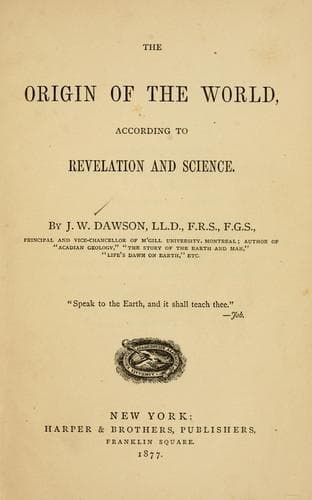
The Origin of the World According to Revelation and ScienceDawson, John William, Sir
Religion
The Origin of the World According to Revelation and Science
Dawson, John William, Sir
Bible and science; Religion and science
8. In the department of "final causes," as they have been termed,
Scripture and geology unite in affording large and interesting views.
They illustrate the procedure of the All-wise Creator during a long
succession of ages, and thus enable us to see the effects of any of
his laws, not only at one time, but in far distant periods. To reject
the consideration of this peculiarity of geological science would be
the extremest folly, and would involve at once a misinterpretation of
the geologic record and a denial of the agency of an intelligent
Designer as revealed in Scripture, and indicated by the succession of
beings. Many of the past changes of the earth acquire their full
significance only when taken in connection with the present wants of
the earth's inhabitants; and along the whole course of the geological
history the creatures that we meet with are equally rich in the
evidences of nice adaptation to circumstances and wonderful
contrivances for special ends, with their modern representatives. As
an example of the former, how wonderful is the connection of the
great vegetable accumulations of the ancient coal swamps, and the
bands and nodules of iron-stone which were separated from the
ferruginous sands or clays in their vicinity by the action of this
very vegetable matter, with the whole fabric of modern civilization,
and especially with the prosperity of that race which, in our time,
stands in the front of the world's progress. In a very ancient period,
wide swamps and deltas, teeming with vegetable life, and which, if
they now existed, would be but pestilent breeders of miasmata, spread
over large tracts of the northern hemisphere, on which marine animals
had previously accumulated thick sheets of limestone. Vast beds of
vegetable matter were collected by growth in these swamps, and the
waste particles that passed off in the form of organic acids were
employed in concentrating the oxide of iron in underlying clays and
sands. In the lapse of ages the whole of these accumulations were
buried deep in the crust of the earth; and long periods succeeded,
when the earth was tenanted by reptilian and other creatures,
unconscious of the treasures beneath them. The modern period arrived.
The equable climate of the coal era had passed away. Continents were
prepared for the residence of man, and the edges of the old
carboniferous beds were exposed by subterranean movements, and laid
bare by denudation. Man was introduced, fell from his state of
innocence, and was condemned to earn his subsistence by the sweat of
his brow; and now for the first time appears the use of these buried
coal swamps. They now afford at once the materials of improvement in
the arts and of comfortable subsistence in extreme climates, and
subjects of surpassing interest to the naturalist. Similar instances
may be gleaned by the natural theologian from nearly every part of the
geological history.
Public-domain text, read in full here on John Shaqi.
Reviews
Reviews
No reviews yet
Be the first to share your thoughts on this work.
Elsewhere in the archive
Join the Discussion
Join the discussion
Sign in to leave a comment or review.
Sign InorCreate an account