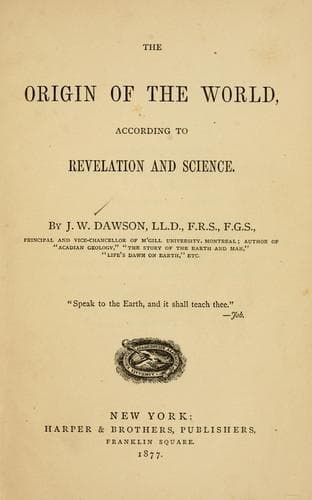
The Origin of the World According to Revelation and ScienceDawson, John William, Sir
Religion
The Origin of the World According to Revelation and Science
Dawson, John William, Sir
Bible and science; Religion and science
Evolutionist writers have a great horror of what they term
"intervention." But they should be informed that the idea of a
planning Creator does not involve intervention in an extraordinary or
miraculous sense, any more than what we call the ordinary operations
of nature. It is a common but childish prejudice that every discovery
of a secondary cause diminishes so much of what is to be referred to
the agency of God. On the contrary, such discoveries merely aid us in
comprehending the manner of his action. But when evolutionists, in
their zeal to get rid of creative intervention, trace all things to
the interaction of insensate causes, they fall into the absurdity of
believing in absolute unmitigated chance as the cause of perfect
order. Evidences of this may be found by the score in Darwin's works
on the origin of species. I quote, however, from another and usually
clear thinker, Wallace, in a review of the Duke of Argyll's "Reign of
Law," which appeared some years ago, but represents very well this
phase of thought:
"'It is curious,' says the Duke of Argyll, 'to observe the language
which this most advanced disciple of pure naturalism [Mr. Darwin]
instinctively uses, when he has to describe the complicated structure
of this curious order of plants [the Orchids]. Caution in ascribing
intentions to nature does not seem to occur to him as possible.
Intention is the one thing which he does see, and which, when he does
not see, he seeks for diligently until he finds it. He exhausts every
form of words and of illustration by which intention or mental purpose
can be described. 'Contrivance'--'curious contrivance'--'beautiful
contrivance'--these are expressions which occur over and over again.
Here is one sentence describing the parts of a particular species:
'the labellum is developed into a long nectary, _in order_ to attract
lepidoptera, and we shall presently give reason for suspecting that
the nectar is _purposely_ so lodged that it can be sucked only slowly,
_in order_ to give time for the curious chemical quality of this
viscid matter setting hard and dry.'" Many other examples of similar
expressions are quoted by the duke, who maintains that no explanation
of these "contrivances" has been or can be given, except on the
supposition of a personal contriver, specially arranging the details
of each case, although causing them to be produced by the ordinary
processes of growth and reproduction.
Public-domain text, read in full here on John Shaqi.
Reviews
Reviews
No reviews yet
Be the first to share your thoughts on this work.
Elsewhere in the archive
Join the Discussion
Join the discussion
Sign in to leave a comment or review.
Sign InorCreate an account