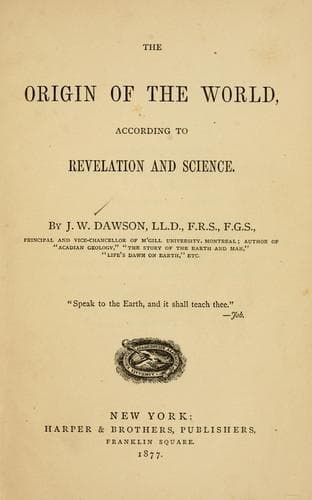
The Origin of the World According to Revelation and ScienceDawson, John William, Sir
Religion
The Origin of the World According to Revelation and Science
Dawson, John William, Sir
Bible and science; Religion and science
"(2.) Whatever importance we may attach to the above supposed causes
of change, we still require to account for the origin of our specific
types. This may forever elude our observation, but we may at least
hope to ascertain the external conditions favorable to their
production. In order to attain even to this it will be necessary to
inquire critically, with reference to every acknowledged species, what
its claims to distinctness are, so that we may be enabled to
distinguish specific types from mere varieties. Having attained to
some certainty in this, we may be prepared to inquire whether the
conditions favorable to the appearance of new varieties were also
those favorable to the creation of new types, or the reverse--whether
these conditions were those of compression or expansion, or to what
extent the appearance of new types may be independent of any external
conditions, other than those absolutely necessary for their existence.
I am not without hope that the further study of fossil plants may
enable us thus to approach to a comprehension of the laws of the
creation, as distinguished from those of the continued existence of
species.
"In the present state of our knowledge we have no good ground either
to limit the number of specific types beyond what a fair study of our
material may warrant, or to infer that such primitive types must
necessarily have been of low grade, or that progress in varietal forms
has always been upward. The occurrence of such an advanced and
specialized type as that of _Syringoxylon_ in the Middle Devonian
should guard us against these errors. The creative process may have
been applicable to the highest as well as to the lowest forms, and
subsequent deviations must have included degradation as well as
elevation. I can conceive nothing more unreasonable than the statement
sometimes made that it is illogical or even absurd to suppose that
highly organized beings could have been produced except by derivation
from previously existing organisms. This is begging the whole question
at issue, depriving science of a noble department of inquiry on which
it has as yet barely entered, and anticipating by unwarranted
assertions conclusions which may perhaps suddenly dawn upon us through
the inspiration of some great intellect, or may for generations to
come baffle the united exertions of all the earnest promoters of
natural science. Our present attitude should not be that of
dogmatists, but that of patient workers content to labor for a harvest
of grand generalizations which may not come till we have passed away,
but which, if we are earnest and true to nature and its Creator, may
reward even some of us."[152]
D.--PRESENT CONDITION OF THEORIES OF LIFE.
One of the most learned and ingenious essays on this subject recently
published[153] states on its first page that all the varieties of
opinion may be summed up under two heads:
Public-domain text, read in full here on John Shaqi.
Reviews
Reviews
No reviews yet
Be the first to share your thoughts on this work.
Elsewhere in the archive
Join the Discussion
Join the discussion
Sign in to leave a comment or review.
Sign InorCreate an account