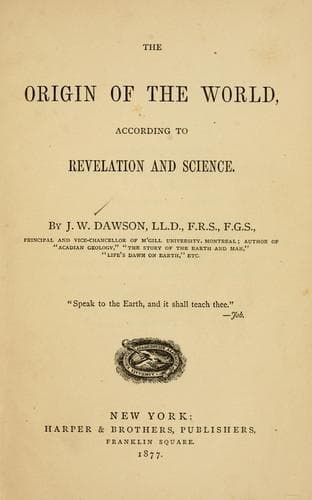
The Origin of the World According to Revelation and ScienceDawson, John William, Sir
Religion
The Origin of the World According to Revelation and Science
Dawson, John William, Sir
Bible and science; Religion and science
surrounded this primitive rock must have been of immense density.
Under the pressure of such a high barometric column, condensation
would take place at a temperature much above the present boiling-point
of water, and the depressed portions of the half-cooled crust would be
flooded with a highly heated solution of hydrochloric acid, whose
action in decomposing the silicates is easily intelligible to the
chemist. The formation of chlorides of the various bases, and the
separation of silica, would go on until the affinities of the acid
were satisfied, and there would be a separation of silica, taking the
form of quartz, and the production of a sea-water holding in solution,
besides the chlorides of sodium, calcium, and magnesium, salts of
aluminium and other metallic bases. The atmosphere, being thus
deprived of its volatile chlorine and sulphur compounds, would
approximate to that of our own time, but differ in its greater amount
of carbonic acid.
"We next enter into the second phase in the action of the atmosphere
upon the earth's crust. This, unlike the first, which was subaqueous,
or operative only on the portion covered with the precipitated water,
is sub-aerial, and consists in the decomposition of the exposed parts
of the primitive crust under the influence of the carbonic acid and
moisture of the air, which convert the complex silicates of the crust
into a silicate of alumina, or clay, while the separated lime,
magnesia, and alkalies, being converted into carbonates, are carried
down into the sea in a state of solution.
"The first effect of these dissolved carbonates would be to
precipitate the dissolved alumina and the heavy metals, after which
would result a decomposition of the chloride of calcium of the
sea-water, resulting in the production of carbonate of lime or
limestone, and chloride of sodium or common salt. This process is one
still going on at the earth's surface, slowly breaking down and
destroying the hardest rocks, and, aided by mechanical processes,
transforming them into clays; although the action, from the
comparative rarity of carbonic acid in the atmosphere, is less
energetic than in earlier times, when the abundance of this gas, and a
higher temperature, favored the chemical decomposition of the rocks.
But now, as then, every clod of clay formed from the decay of a
crystalline rock corresponded to an equivalent of carbonic acid
abstracted from the atmosphere, and equivalents of carbonate of lime
and common salt formed from the chloride of calcium of the
sea-water."[159]
H.--TANNIN AND BHEMAH.
The following synopsis of the instances of the occurrence of the words
_tannin_ and _tan_ will serve to show the propriety of the meaning,
"great reptiles," assigned in the text to the former, as well as to
illustrate the utility in such cases of "comparing Scripture with
Scripture:"
1. TANNIN.
Public-domain text, read in full here on John Shaqi.
Reviews
Reviews
No reviews yet
Be the first to share your thoughts on this work.
Elsewhere in the archive
Join the Discussion
Join the discussion
Sign in to leave a comment or review.
Sign InorCreate an account