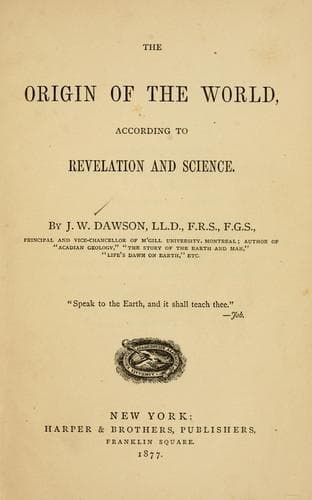
The Origin of the World According to Revelation and ScienceDawson, John William, Sir
Religion
The Origin of the World According to Revelation and Science
Dawson, John William, Sir
Bible and science; Religion and science
3. The duration or permanence of varieties is very different. Some
return at once to the normal type when the causes of change are
removed. Others perpetuate themselves nearly as invariably as species,
and are named races. It is these races only that we are likely to
mistake for true species, since here we have that permanent
reproduction which is one of the characteristics of the species. The
race, however, wants the other characteristics of species as above
stated; and it differs essentially in having branched from a primitive
species, and in not having an independent origin. It is quite evident
that in the absence of historical evidence we must be very likely to
err by supposing races to have really originated in distinct
"primordial forms." Such error is especially likely to arise if we
overlook the fact of the sudden origination of such races, and their
great permanency if kept distinct. There are two facts which deserve
especial notice, as removing some of the difficulty in such cases. One
is that well-marked races usually originate only in domesticated
animals, or in wild animals which, owing to accidental circumstances,
are placed in abnormal circumstances. Another is, that there always
remains a tendency to return, in favorable circumstances, to the
original type. This tendency to reversion is much underrated by Darwin
and his followers; yet they constantly recur to it as a means of
proving possible derivation, and their writings abound in examples of
it. Perhaps the most remarkable of these reversions are those which
occur when varieties destitute of all the markings of the original
stock are crossed and reproduce those markings, which Darwin shows to
occur in pigeons and domestic fowls. The domesticated races usually
require a certain amount of care to preserve them in a state of
purity, both on this account and on account of the readiness with
which they intermix with other varieties of the same species. Many
very interesting facts in illustration of these points might be
adduced. The domesticated hog differs in many important characters
from the wild boar. In South America and the West Indies it has
returned, in three centuries or less, to its original form.[162] The
horse is probably not known in a state originally wild, but it has run
wild in America and in Siberia. In the prairies of North America,
according to Catlin[163] they still show great varieties of color. The
same is the case in Sable Island, off the coast of Nova Scotia[164]
where herds of wild horses have existed since an early period in the
settlement of America. In South America and Siberia they have assumed
a uniform chestnut or bay color. In the plains of Western America they
retain the dimensions and vigor of the better breeds of domesticated
horses. In Sable Island they have already degenerated to the level of
Highland ponies; but in all countries where they have run wild, the
elongated and arched head, high shoulders, straight back, and other
Public-domain text, read in full here on John Shaqi.
Reviews
Reviews
No reviews yet
Be the first to share your thoughts on this work.
Elsewhere in the archive
Join the Discussion
Join the discussion
Sign in to leave a comment or review.
Sign InorCreate an account