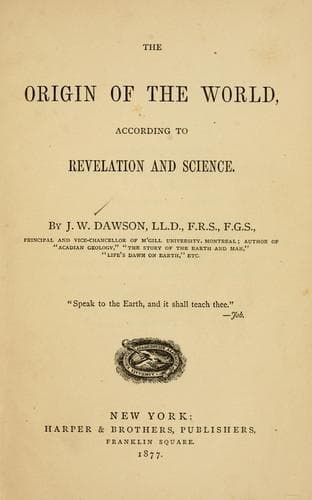
The Origin of the World According to Revelation and ScienceDawson, John William, Sir
Religion
The Origin of the World According to Revelation and Science
Dawson, John William, Sir
Bible and science; Religion and science
Again, no adequate allowance has been made in the case of these forms
of skull for the influence of modes of nurture in infancy. Dr. Morton,
observing that the brachy-kephalic American skull was often unequal
sided, and the occiput much flattened, suggests that this is "an
exaggeration of the natural form produced by the pressure of the
cradle-board in common use among the American natives." Dr. Wilson has
noticed the same unsymmetrical character in brachy-kephalic skulls in
British barrows, and has suspected some artificial agency in infancy;
and says, in reference to the American instances, "I think it
extremely probable that further investigation will tend to the
conclusion that the vertical or flattened occiput, instead of being a
typical characteristic, pertains entirely to the class of artificial
modifications of the natural cranium familiar to the American
ethnologist."
While the points in which the races of men vary are those in which
lower animals are most liable to undergo change, the several races
display a remarkable constancy in those which are usually less
variable. Prichard and Carpenter have well shown this in relation to
physiological points, as, for instance, the age of arriving at
maturity, the average and extreme duration of life, and the several
periods connected with reproduction. The coincidence in these points
alone is by many eminent physiologists justly regarded as sufficient
evidence of the unity of the species.
4. It may also be affirmed, in relation to the varieties of man, that
they do not exceed in amount or extent those observed in the lower
animals. If with Frederick Cuvier, Dr. Carpenter, and many other
naturalists, we regard the dog as a single species, descended in all
probability from the wolf, we can have no hesitation in concluding
that this animal far exceeds man in variability.[171] But this is
denied by many, not without some show of reason; and we may,
therefore, select some animal respecting which little doubt can be
entertained. Perhaps the best example is the common hog (_Sus
scrofa_), an undoubted descendant of the wild boar, and a creature
especially suitable for comparison with man, inasmuch as its possible
range of food is very much the same with his, which is not the case
with any other of our domesticated animals; and as its headquarters as
a species are in the same regions which have supported the greatest
and oldest known communities of men. We may exclude from our
comparison the Chinese hog, by some regarded as a distinct species
(_Sus Indicus_), though no wild original is known, and it breeds
freely with the common hog. The color of the domestic hog varies, like
that of man, from white to black; and in the black hog the skin as
well as the hair partakes of the dark color. The abundance and
quality of the hair vary extremely; the stature and form are equally
variable, much more so than in man. Blumenbach long ago remarked that
Public-domain text, read in full here on John Shaqi.
Reviews
Reviews
No reviews yet
Be the first to share your thoughts on this work.
Elsewhere in the archive
Join the Discussion
Join the discussion
Sign in to leave a comment or review.
Sign InorCreate an account