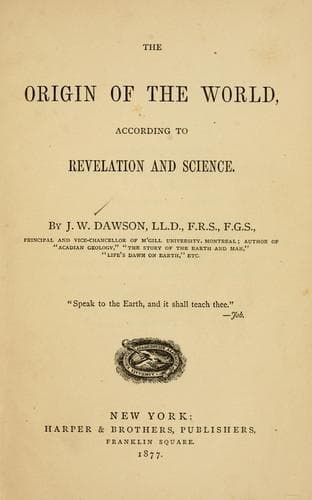
The Origin of the World According to Revelation and ScienceDawson, John William, Sir
Religion
The Origin of the World According to Revelation and Science
Dawson, John William, Sir
Bible and science; Religion and science
If the reader happens to be familiar with the objections to the
doctrine of final causes, or teleology, in nature, urged in our day
by Spencer, Haeckel, and others, he will have seen from the foregoing
statements that these objections are in themselves baseless, or
inapplicable to this doctrine as maintained in the Bible. There is no
consistency in the position of men who, when they dig a rudely chipped
flint out of a bed of gravel, immediately infer an intelligent
workman, and who refuse to see any indication of a higher intelligence
in the creation of the workman himself. It is a blind philosophy which
professes to see in primal atoms the "promise and potency of mind,"
and which fails to perceive that such potency is more inconceivable
than the evidence of primary and supreme mind. The men who maintain
that wings were not planned for flight, but that flight has produced
wings, and thousands of like propositions, are simply amusing
themselves with paradoxes to which may very properly be applied the
strange word devised by Haeckel to express his theory of
nature--_Dysteleology_, or purposelessness. It is to be borne in mind,
however, that the teleology of the Bible is not of that narrow kind
which would make man the sole object of nature, and the supreme judge
of its adaptations. Inasmuch as God's plan goes over all the ages past
and future, and relates to the welfare of all sentient beings known or
unknown to us, and also to his own sovereign pleasure as the supreme
object, we may not be in a position either to understand or profit by
all its parts, and hence may expect to find many mysteries, and many
things that we can not at present reconcile with God's wisdom and
goodness. We know but "parts of his ways," the "fullness of his power
who can understand." "His judgments are unsearchable," "his ways are
past finding out."
Public-domain text, read in full here on John Shaqi.
Reviews
Reviews
No reviews yet
Be the first to share your thoughts on this work.
Elsewhere in the archive
Join the Discussion
Join the discussion
Sign in to leave a comment or review.
Sign InorCreate an account