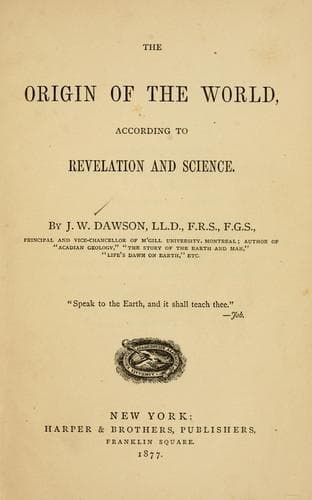
The Origin of the World According to Revelation and ScienceDawson, John William, Sir
Religion
The Origin of the World According to Revelation and Science
Dawson, John William, Sir
Bible and science; Religion and science
4. The law of type or pattern in nature is distinctly indicated in the
Bible. This is a principle only recently understood by naturalists,
but it has more or less dimly dawned on the minds of many great
thinkers in all ages. Nor is this wonderful, for the idea of type is
scarcely ever absent from our own conceptions of any work that we may
undertake. In any such work we anticipate recurring daily toil, like
the returning cycles of nature. We look for progress, like that of the
growth of the universe. We study adaptation both of the several parts
to subordinate uses, and of the whole to some general design. But we
also keep in view some pattern, style, or order, according to which
the whole is arranged, and the mutual relations of the parts are
adjusted. The architect must adhere to some order of architecture, and
to some style within that order. The potter, the calico-printer, and
the silversmith must equally study uniformity of pattern in their
several manufactures. The Almighty Worker has exhibited the same idea
in his works. In the animal kingdom, for instance, we have four or
more leading types of structure. Taking any one of these--the
vertebrate, for example--we have a uniform general plan, embracing the
vertebral column constructed of the same elements; the members,
whether the arm of man, the limb of the quadruped, or the wing of the
bat or the bird, or the swimming-paddle of the whale, built of the
same bones. In like manner all the parts of the vertebral column
itself in the same animal, whether in the skull, the neck, or the
trunk, are composed of the same elementary structures. These types are
farther found to be sketched out--first in their more general, and
then in their special features--in proceeding from the lower species
of the same type to the higher, in proceeding from the earlier to the
later stages of embryonic development, and in proceeding from the more
ancient to the more recent creatures that have succeeded each other in
geological time. Man, the highest of the vertebrates, is thus the
archetype, representing and including all the lower and earlier
members of the vertebrate type. The above are but trite and familiar
examples of a doctrine which may furbish and has furnished the
material of volumes. There can be no question that the Hebrew Bible is
the oldest book in which this principle is stated. In the first
chapter of Genesis we have specific type in the creation of plants and
animals after their kinds or species, and in the formation of man in
the image and likeness of the Creator; and, as we shall find in the
sequel, there are some curious ideas of higher and more general types
in the grouping of the creatures referred to. The same idea is
indicated in the closing chapters of Job, where the three higher
classes of the vertebrates are represented by a number of examples,
and the typical likeness of one of these--the hippopotamus--to man,
seems to be recognized. Dr. McCosh has quoted, as an illustration of
Public-domain text, read in full here on John Shaqi.
Reviews
Reviews
No reviews yet
Be the first to share your thoughts on this work.
Elsewhere in the archive
Join the Discussion
Join the discussion
Sign in to leave a comment or review.
Sign InorCreate an account