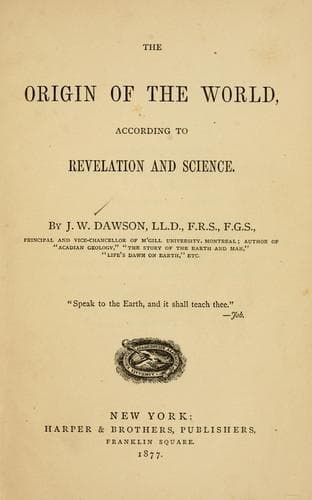
The Origin of the World According to Revelation and ScienceDawson, John William, Sir
Religion
The Origin of the World According to Revelation and Science
Dawson, John William, Sir
Bible and science; Religion and science
the doctrine of types, a very remarkable passage from Psalm cxxxix.:
"I will praise Thee, for I am fearfully and wonderfully made.
Marvellous are thy works,
And that my soul knoweth right well.
My substance was not hid from Thee,
When I was made in secret,
And curiously wrought in the lowest parts of the earth:
Thine eyes did see my substance, yet being imperfect;
And in thy book all my members were written,
Which in continuance were fashioned when as yet there
was none of them."
It would too much tax the faith of many to ask them to believe that
the writer of the above passage, or the Spirit that inspired him,
actually meant to teach--what we now know so well from geology--that
the prototypes of all the parts of the archetypal human structure may
be found in those fossil remains of extinct animals which may, in
nearly every country, be dug up from the rocks of the earth. No
objection need, however, be taken to our reading in it the doctrine of
embryonic development according to a systematic type.
Science, it is true, or rather I should perhaps say philosophical
speculation, has sometimes pushed this idea of plan into that of a
spontaneous genetic evolution of things in time, without any creative
superintendence or definite purpose. This way of viewing the matter
is, however, as we shall have occasion to see, both bald and
irrational, and wants the symmetry and completeness of that style of
thought which grasps at once progress and plan and adaptation, as
emanating from a Supreme Will. The question of how the plan has been
worked out will come up for detailed consideration farther on. In the
mean time we have before us the fact that the Bible represents the
cosmos as not the product of a blind conflict of self-existent forces,
but as the result of the production and guidance of these forces by
infinite wisdom.
It is more than curious that this idea of type, so long existing in an
isolated and often depised form, as a theological thought in the
imagery of Scripture, should now be a leading idea of natural science;
and that while comparative anatomy teaches us that the structures of
all past and present lower animals point to man, who, as Professor
Owen expresses it, has had all his parts and organs "sketched out in
anticipation in the inferior animals," the Bible points still farther
forward to an exaltation of the human type itself into what even the
comparative anatomist might perhaps regard as among the "possible
modifications of it beyond those realized in this little orb of ours,"
could he but learn its real nature.
Public-domain text, read in full here on John Shaqi.
Reviews
Reviews
No reviews yet
Be the first to share your thoughts on this work.
Elsewhere in the archive
Join the Discussion
Join the discussion
Sign in to leave a comment or review.
Sign InorCreate an account