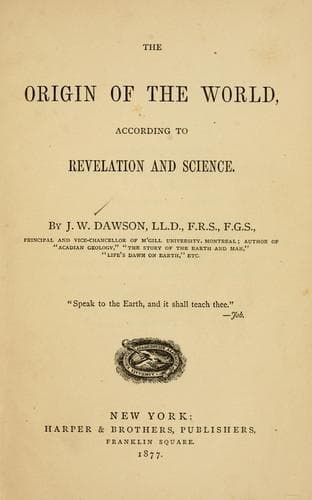
The Origin of the World According to Revelation and ScienceDawson, John William, Sir
Religion
The Origin of the World According to Revelation and Science
Dawson, John William, Sir
Bible and science; Religion and science
The author of creation is Elohim, or God in his general aspect to
nature and man, and not in that special aspect in reference to the
Hebrew commonwealth and to the work of redemption indicated by the
name Jehovah (_Iaveh_). We need not enter into the doubtful etymology
of the word; but may content ourselves with that supported by many,
perhaps the majority of authorities, which gives it the meaning of
"Object of dread or adoration," or with that preferred by Gesenius,
which makes it mean the "Strong or mighty one." Its plural form has
also greatly tried the ingenuity of the commentators. After carefully
considering the various hypotheses, such as that of the plural of
majesty of the Rabbins, and the primitive polytheism supposed by
certain Rationalists, I can see no better reason than an attempt to
give a grammatical expression to that plurality in unity indicated by
the appearance of the Spirit or breath of God and his Word, or
manifested will and power, as distinct agents in the succeeding
verses. This was probably always held by the Hebrews in a general
form; and was by our Saviour and his apostles specialized in that
trinitarian doctrine which enables both John and Paul explicitly to
assert the agency of the second person of the Trinity in the creative
work.
This elementary trinitarian idea of the first chapter of Genesis may
be further stated thus: The name Elohim expresses the absolute
unconditioned will and reason--the Godhead. The manifestation of God
in creative power, and in the framing and ordering of the cosmos, is
represented by the formula "God said"--the equivalent of the Divine
Word. The further manifestation of God in love of and sympathy with
his work is represented by the Breath of God, and by the expression,
"God saw that it was good"--operations these of the Divine Spirit.
The aboriginal root of the word Elohim probably lies far back of the
Semitic literature, and comes from the natural exclamations "al,"
"lo," "la," which arise from the spontaneous action of the human vocal
organs in the presence of any object of awe or wonder. The plural form
may in like manner be simply equivalent to our terms Godhead or
Divinity, implying all that is essentially God without specification
or distinction of personalities. As Dr. Tayler Lewis well remarks in
his "Introduction to Genesis," we should not dismiss such plurals as
mere _usus loquendi_. The plural form of the name of God, of the
heavens (literally, the "heights"), of the _olamim_, or time-worlds,
of the word for life in Genesis (lives), indicates an idea of vastness
and diversity not measurable by speech, which must have been impressed
on the minds of early men, otherwise these forms would not have
arisen. God, heaven, time, life, were to them existences stretching
outward to infinity, and not to be denoted by the bare singular form
suitable to ordinary objects.
Public-domain text, read in full here on John Shaqi.
Reviews
Reviews
No reviews yet
Be the first to share your thoughts on this work.
Elsewhere in the archive
Join the Discussion
Join the discussion
Sign in to leave a comment or review.
Sign InorCreate an account