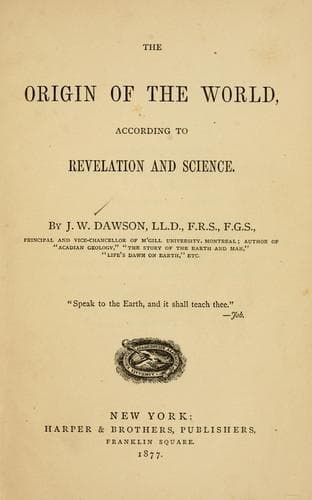
The Origin of the World According to Revelation and ScienceDawson, John William, Sir
Religion
The Origin of the World According to Revelation and Science
Dawson, John William, Sir
Bible and science; Religion and science
In the present connection these words inform us that the earth was in
a chaotic state, and unfit for the residence of organized beings. The
words themselves suggest the important question: Are they intended to
represent this as the original condition of the earth? Was it a scene
of desolation and confusion when it sprang from the hand of its
Creator? or was this state of ruin consequent on convulsions which
may have been preceded by a very different condition, not mentioned by
the inspired historian? That it may have been so is rendered possible
by the circumstance that the words employed are generally used to
denote the ruin of places formerly inhabited, and by the want of any
necessary connection in time between the first and second verses. It
has even been proposed, though this does violence to the construction,
to read "and the earth became" desolate and empty. Farther, it seems,
_a priori_, improbable that the first act of creative power should
have resulted in the production of a mere chaos. The crust of the
earth also shows, in its alternations of strata and organic remains,
evidence of a great series of changes extending over vast periods, and
which might, in a revelation intended for moral purposes, with great
propriety be omitted.
For such reasons some eminent expositors of these words are disposed
to consider the first verse as a title or introduction, and to refer
to this period the whole series of geological changes; and this view
has formed one of the most popular solutions of the apparent
discrepancies between the geological and Scriptural histories of the
world. It is evident, however, that if we continue to view the term
"earth" as including the whole globe, this hypothesis becomes
altogether untenable. The subsequent verses inform us that at the
period in question the earth was covered by a universal ocean,
possessed no atmosphere and received no light, and had not entered
into its present relations with the other bodies of our system. No
conceivable convulsions could have effected such changes on an earth
previously possessing these arrangements; and geology assures us that
the existing laws and dispositions in these respects have prevailed
from the earliest periods to which it can lead us back, and that the
modern state of things was not separated from those which preceded it
by any such general chaos. To avoid this difficulty, which has been
much more strongly felt as these facts have been more and more clearly
developed by modern science, it has been held that the word earth may
denote only a particular region, temporarily obscured and reduced to
ruin, and about to be fitted up, by the operations of the six days,
for the residence of man; and that consequently the narrative of the
six days refers not to the original arrangement of the surface,
relations, and inhabitants of our planet, but to the retrieval from
ruin and repeopling of a limited territory, supposed to have been in
Public-domain text, read in full here on John Shaqi.
Reviews
Reviews
No reviews yet
Be the first to share your thoughts on this work.
Elsewhere in the archive
Join the Discussion
Join the discussion
Sign in to leave a comment or review.
Sign InorCreate an account