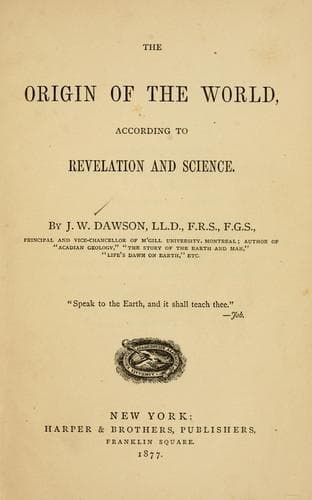
The Origin of the World According to Revelation and ScienceDawson, John William, Sir
Religion
The Origin of the World According to Revelation and Science
Dawson, John William, Sir
Bible and science; Religion and science
Before leaving this part of the subject, I may remark that the
desolate and empty condition of the earth was not necessarily a
chaotic mass of confusion--_rudis indigestaque moles_; but in reality,
when physically considered, may have been a more symmetrical and
homogeneous condition than any that it subsequently assumed. If the
earth were first a vast globe of vapor, then a liquid spheroid, and
then acquired a crust not yet seamed by fissures or broken by
corrugations, and eventually covered with a universal ocean, then in
each of these early conditions it would, in regard to its form, be a
more perfect globe than at any succeeding time. That something of this
kind is the intention of our historian is implied in his subsequent
statements as to the absence of land and the prevalence of a universal
ocean in the immediately succeeding period, which imply that the crust
had not yet been ruptured or disturbed, but presented an even and
uniform surface, no part of which could project above the
comparatively thin fluid envelope.
The second clause introduces a new object--"_the deep_." Whatever its
precise nature, this is evidently something included in the earth of
verse 1st, and created with it. The word occurs in other parts of the
Hebrew Scriptures in various senses. It often denotes the sea,
especially when in an agitated state (Psa. xlii., 8; Job xxxviii.,
10). In Psalm cxxxv., however, it is distinguished from the sea:
"Whatsoever the Lord pleased, that did he in heaven, in the earth, in
the seas, and _in all deeps_." In other cases it has been supposed to
refer to interior recesses of the earth, as when at the deluge "the
fountains of the great deep" are said to have been broken up. It is
probable, however, that this refers to the ocean. In some places it
would appear to mean the atmosphere or its waters; as Prov. viii.,
27-29, "When he prepared the heavens, I was there; when he described a
circle on the face of the deep, when he established the clouds above,
when he strengthened the fountains of the deep." The Septuagint in
this passage reads "throne on the winds" and "fountains under the
heaven."[39] Though we can not attach much value to these readings,
there seems little reason to doubt that the author of this passage
understands by the deep the atmospheric waters, and not the sea,
which he mentions separately. The same meaning must be attached to the
word in another passage of the Book of Proverbs: "The Lord in wisdom
hath founded the earth, by understanding hath he established the
heavens; by his knowledge the depths are broken up, and the clouds
drop down the small rain."
Public-domain text, read in full here on John Shaqi.
Reviews
Reviews
No reviews yet
Be the first to share your thoughts on this work.
Elsewhere in the archive
Join the Discussion
Join the discussion
Sign in to leave a comment or review.
Sign InorCreate an account