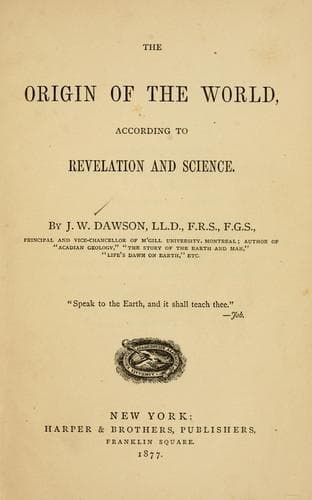
The Origin of the World According to Revelation and ScienceDawson, John William, Sir
Religion
The Origin of the World According to Revelation and Science
Dawson, John William, Sir
Bible and science; Religion and science
Some commentators, both Jewish and Christian, are, however, disposed
to view the _Ruach Elohim_, Spirit, or breath of God, as meaning a
wind of God, or mighty wind, according to a well-known Hebrew idiom.
The word in its primary sense means wind or breath, and there are
undoubted instances of the expression "wind of God" for a great or
strong wind. For example, Isaiah xl., 7: "The grass withereth because
the wind of the Lord bloweth upon it;" see also 2 Kings ii., 16. Such
examples, however, are very rare, and by no means sufficient of
themselves to establish this interpretation. Those who hold this view
do so mainly in consideration of the advantage which it affords in
attaching a definite meaning to the expression. Many of them are not,
however, aware of its precise import in a cosmical point of view. A
violent wind, before the formation of the atmosphere, and the
establishment of the laws which regulate the suspension and motions of
aqueous vapors and clouds, must have been merely an agitation of the
confused misty and vaporous mass of the deep; since, as
Ainsworth--more careful than modern interpreters--long ago observed,
"winde (which is the moving of the aier) was not created till the
second day, that the firmament was spred, and the aier made." Such an
agitation is by no means improbable. It would be a very likely
accompaniment of a boiling ocean, resting on a heated surface, and of
excessive condensation of moisture in the upper regions of the
atmosphere; and might act as an influential means of preparing the
earth for the operations of the second day. It is curious also that
the Phoenician cosmogony is said to have contained the idea of a
mighty wind in connection with this part of creation, and the idea of
seething or commotion in the primitive chaos also occurs in the
Assyrian tablets of creation, while the Quiche legend represents
Hurakon, the storm-god, as specially concerned in the creative
work.[40] On the other hand, the verb used in the text rather
expresses hovering or brooding than violent motion, and this better
corresponds with the old fable of the mundane egg, which seems to have
been derived from the event recorded in this verse. The more
evangelical view, which supposes the Holy Spirit to be intended, is
also more in accordance with the general scope of the Scripture
teachings on this subject; and the opposite idea is, as Calvin well
says, "too frigid" to meet with much favor from evangelical
theologians.
Public-domain text, read in full here on John Shaqi.
Reviews
Reviews
No reviews yet
Be the first to share your thoughts on this work.
Elsewhere in the archive
Join the Discussion
Join the discussion
Sign in to leave a comment or review.
Sign InorCreate an account