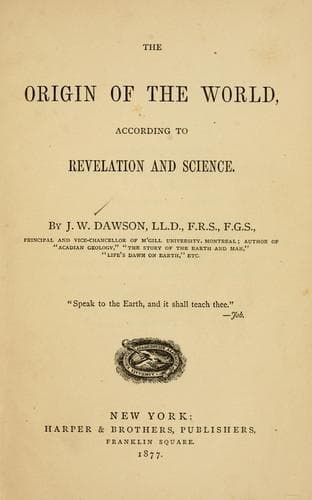
The Origin of the World According to Revelation and ScienceDawson, John William, Sir
Religion
The Origin of the World According to Revelation and Science
Dawson, John William, Sir
Bible and science; Religion and science
"The common objection to that special view which regards the days of
creation as immensely protracted periods of time, furnishes a
specimen, if not of reasoning in a circle, at least of reasoning from
a mere assumption. It first takes for granted that the Sabbath-day
during which God rested was a day of but twenty-four hours, and then
argues from the supposition that, in order to keep up the proportion
between the six previous working days and the seventh day of rest,
which the reason annexed to the fourth commandment demands, these
previous days must also have been twenty-four hours each. It would, I
have begun to suspect, square better with the ascertained facts, and
be at least equally in accordance with Scripture, to reverse the
process, and argue that because God's working days were immensely
protracted periods, his Sabbath also must be an immensely protracted
period. The reason attached to the law of the Sabbath seems to be
simply a reason of proportion: the objection to which I refer is an
objection palpably founded on considerations of proportion, and
certainly were the reason to be divested of proportion, it would be
divested also of its distinctive character as a reason. Were it as
follows, it could not be at all understood: "Six days shalt thou
labor, etc.; but on the seventh day shalt thou do no labor, etc.; for
in six immensely protracted periods of several thousand years each did
the Lord make the heavens and the earth, etc.; and then rested during
a brief day of twenty-four hours; therefore the Lord blessed the brief
day of twenty-four hours and hallowed it." This, I repeat, would not
be reason. All, however, that seems necessary to the integrity of the
reason, in its character as such, is that the proportion of six parts
to seven should be maintained. God's periods may be periods expressed
algebraically by letters symbolical of unknown quantities, and man's
periods by letters symbolical of quantities well known; but if God's
Sabbath be equal to one of his six working days, and man's Sabbath
equal to one of his six working days, the integrity of proportion is
maintained."
Not only does this view of the case entirely remove the objection,
but, as we have already seen, it throws a new light on the nature and
reason of the Sabbath. No good reason, except that of setting an
example, can be assigned for God's resting for a literal day. But if
God's Sabbath of rest from natural creation is still in progress, and
if our short Sabbaths are symbolical of the work of that great Sabbath
in its present gray morning and in its coming glorious noon, then may
the Christian thank this question, incidentally raised by geology and
its long periods, for a ray of light which shines along the whole
course of Scripture history, from the first Sabbath up to that final
"rest which remaineth for the people of God."[53]
Public-domain text, read in full here on John Shaqi.
Reviews
Reviews
No reviews yet
Be the first to share your thoughts on this work.
Elsewhere in the archive
Join the Discussion
Join the discussion
Sign in to leave a comment or review.
Sign InorCreate an account