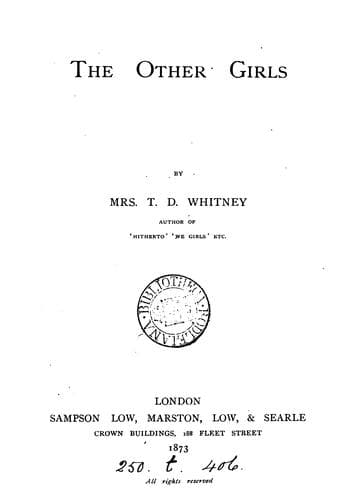
The Other GirlsWhitney, A. D. T. (Adeline Dutton Train)
General
The Other Girls
Whitney, A. D. T. (Adeline Dutton Train)
Family life -- Fiction; Women -- Fiction
Sylvie had insisted upon Desire's receiving the seven dollars a week
which she was still able to pay for her mother's board. Nobody had
told her of Miss Ledwith's very large wealth, and it would have made
no difference if she had known it, except the exciting in her of a
quick question why they had been taken in at all, and whether she
were not indeed being in her turn benevolently practised upon, as
she with much compunction practised upon her mother.
"I know very well that I could not earn, beyond my own board, more
than the difference between that and the ten dollars she would have
to pay anywhere else," she said, simply. And Miss Kirkbright as
simply told Desire, privately, to let it be so.
"If you don't need the pay, she needs the payment," she said.
Desire quietly put it all aside, as she received it. "Sometime or
other I shall be able to tell her all about it, and make her take it
back," she said. "When she has come to understand, she will know
that it is no more mine than hers; and if I do not keep it I can see
very well it will all go after the rest, for whatever whims she can
possibly gratify her mother in."
There began to be happy times for Sylvie now, in Frendely's kitchen,
in Desire's library; all over the house, wherever there was any
little care to take, any service to render. Mrs. Argenter did not
miss her; she read a great deal, and slept a great deal, and Sylvie
was rarely gone long at a time. She was always ready at twilight to
play backgammon, or a game of what she called "skin-deep chess," for
her mother was not able to bear the exertion or excitement of chess
in real, deep earnest. Sylvie brought her sewing, also,--work for
Neighbor Street it was, mostly,--into the gray parlor, and "sewed
for two," on the principle of the fire-watching, that something busy
might be going on in the room, and Mrs. Argenter might have the
content of seeing it.
On the Wednesday evenings recurred the delightful "Read-and-Talk,"
when the Ingrahams came, and Bel Bree, and a dozen or so more of the
"other girls"; when on the big table treasures of picture, map,
stereoscope and story were brought forth; when they traversed far
countries, studied in art-galleries and frescoed churches, traced
back old historic associations; did not hurry or rush, but stayed in
place after place, at point after point, looking it all thoroughly
up, enjoying it like people who could take the world in the leisure
of years. And as they did not have the actual miles to go over, the
standing about to do, and the fatigues to sleep between, they could
"work in the ground fast," like Hamlet, or any other spirit. Their
hours stood for months; their two months had given them already
winters and summers of enchantment.
Public-domain text, read in full here on John Shaqi.
Reviews
Reviews
No reviews yet
Be the first to share your thoughts on this work.
Elsewhere in the archive
Join the Discussion
Join the discussion
Sign in to leave a comment or review.
Sign InorCreate an account