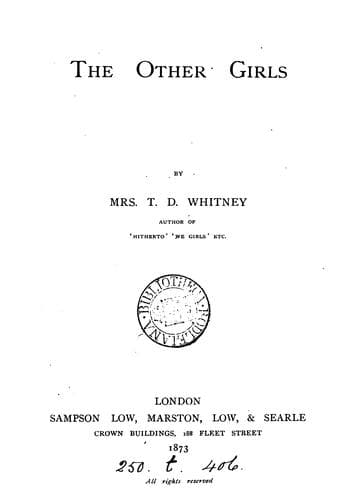
The Other GirlsWhitney, A. D. T. (Adeline Dutton Train)
General
The Other Girls
Whitney, A. D. T. (Adeline Dutton Train)
Family life -- Fiction; Women -- Fiction
"Boffin's Bower" was all alert with aggressive, independent
movement. Here, they did not believe in the divine impulse of the
hour. They would stay on their own side of the line. They would help
themselves and each other. They would stand by their own class, and
cry "hands off!" to the rich women.
What was to be done, for lasting understanding and true relation,
between these conflicting, yet mutually dependent elements?
In their own separate places sat solitary girls and women who sought
neither yet.
Bel Bree was one.
The little room which had been home while Aunt Blin lived there with
her, was suddenly become only a dreary, lonely lodging-room. Cheeps
and Bartholomew were there, chirping and purring, the sun was
shining in; the things were all hers, for Aunt Blin had written one
broad, straggling, unsteady line upon a sheet of paper the last day
she lived, when the fever and confusion had ebbed away out of her
brain as life ebbed slowly back, beaten from its outworks by
disease, toward her heart, and she lay feebly, but clearly,
conscious.
"I give all I leave in the world to my niece Belinda Bree."
"Kellup" came down and buried his sister, and "looked into things;"
concluded that "Bel was pretty comfortable, and with good
folks,--Mrs. Pimminy and Miss Smalley; 'sposed she calc'lated to
keep on, now; she could come back if she wanted to, though."
Bel did not want to. She would stay here a little while, at any
rate, and think. So Kellup went back into New Hampshire.
There was a little money laid up since Miss Bree and Bel had been
together; Bel could get along, she thought, till work began again.
But it was no longer living; it would not be living then; it would
be only work and solitude. She was like a great many others of them
now; girls without tie or belonging,--holding on where they could.
Elise Mokey had said to her,--"See if you could help yourself if you
hadn't Aunt Blin!" and now she began to look forward against that
great, dark "If."
Everything had come together. If work had kept on, there would have
been these little savings to fall back upon when earnings did not
quite meet outlay. But now she should use them up before work came.
And what did it signify, anyhow? All the comfort--all the meaning of
it--was gone.
They were all kind to her; Miss Smalley sat with her evenings, till
Bel wished she would have the wiser kindness to go away and let her
be miserable, just a little while.
Morris Hewland knocked at the door one afternoon when the
music-mistress was out, giving her lessons.
Bel did not ask him in to sit down; she stood just within the
doorway, and talked with him.
He made some friendly inquiries that led to conversation; he drew
her to say something of her plans. He had not come on purpose; he
hardly knew what he had come for. He had only knocked to say a word
of kindness; to look in the poor, pretty little face that he felt
such a tenderness for.
Public-domain text, read in full here on John Shaqi.
Reviews
Reviews
No reviews yet
Be the first to share your thoughts on this work.
Elsewhere in the archive
Join the Discussion
Join the discussion
Sign in to leave a comment or review.
Sign InorCreate an account