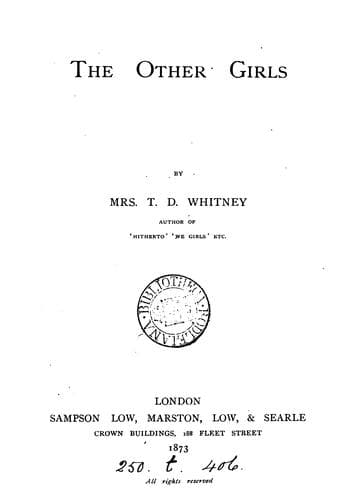
The Other GirlsWhitney, A. D. T. (Adeline Dutton Train)
General
The Other Girls
Whitney, A. D. T. (Adeline Dutton Train)
Family life -- Fiction; Women -- Fiction
No; Desire Ledwith had rather turned away from all special hope,
thinking it was over for her. But she came to believe that all the
good in God's long years was not over; that she had not been
hindered from one thing, save to be kept for some other that He saw
better. She was willing to wait for his better,--his best. When she
paused to look at her life objectively, she rejoiced in it as the
one thread--a thread of changing colors--in God's manifold work,
that He was letting her follow alone with Him, and showing her the
secret beauty of. Up and down, in and out, backward and forward, she
wrought it after his pattern, and discerned continually where it
fell into combinations that she had never planned,--made surprises
for her of effects that were not her own. There is much ridicule of
mere tapestry and broidery work, as a business for women's fingers;
but I think the secret, uninterpreted charm of it, to the silliest
sorters of colors and counters of stitches, is beyond the fact, as
the beauty of children's plays is the parable they cannot help
having in them. Patient and careful doing, after a law and
rule,--and the gradual apparition of result, foreseen by the deviser
of the law and rule; it is life measured out upon a canvas. Who
knows how,--in this spiritual Kindergarten of a world,--the
rudiments of all small human devices were set in human faculty and
aptness for its own object-teaching toward a perfect heavenly
enlightenment?
Desire was thinking to-night, how impossible it is, as the pattern
of life grows, to help seeing a little of the shapes it may be
taking; to refrain from a looking forward that becomes eager with a
hint of possible unfolding.
Once, a while ago, she had thought that she discerned a green beauty
springing out from the dull, half-filled background; tender leaves
forming about a bare and awkward shoot; but suddenly there were no
more stitches in that direction that she could set; the leaves
stopped short in half-developed curves that never were completed.
The pattern set before her--given but one bit at a time, as life
patterns are, like part etchings of a picture in which you know not
how the spaces are to be filled up and related--changed; the place,
and the tint of the thread, changed also; she had to work on in a
new part, and in a different way. She could not discover then, that
these abortive leaves were the slender claspings of a calyx, in
whose midst might sometime fit the rose-bloom of a wonderful joy.
Was she discovering it now? For browns and grays,--generous and
strong, tender and restful,--was a flush of blossom hues that she
had not looked for, coming to be woven in? Was the empty calyx
showing the first shadowy petal-shapes of a most perfect flower?
Public-domain text, read in full here on John Shaqi.
Reviews
Reviews
No reviews yet
Be the first to share your thoughts on this work.
Elsewhere in the archive
Join the Discussion
Join the discussion
Sign in to leave a comment or review.
Sign InorCreate an account