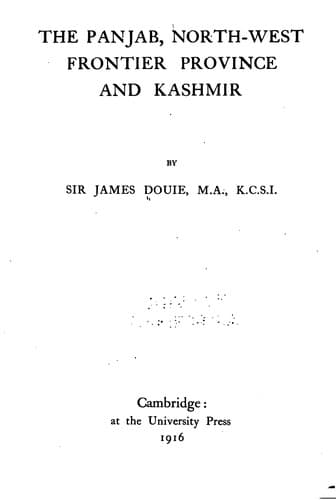
The Panjab, North-West Frontier Province, and KashmirDouie, James McCrone, Sir
History
The Panjab, North-West Frontier Province, and Kashmir
Douie, James McCrone, Sir
India -- Description and travel; Jammu and Kashmir (India); North-west Frontier Province (Pakistan); Punjab (India)
east of the Kutb are the cyclopean ruins of Tughlakabad (page 206).
~Delhi past and present.~--The Delhi of Aurangzeb was as much a camp as a
city. When the Emperor moved to Agra or Kashmir the town was emptied of
a large part of its inhabitants. It contained one or two fine _bazars_,
and nobles and rich merchants and shopkeepers had good houses, set
sometimes in pleasant gardens. But the crowds of servants and followers
occupied mud huts, whose thatched roofs led to frequent and widespread
fires. In that insanitary age these may have been blessings in disguise.
"In Delhi," wrote Bernier, "there is no middle state. A man must either
be of the highest rank or live miserably.... For two or three who wear
decent apparel there may always be reckoned seven or eight poor, ragged,
and miserable beings." The ordinary street architecture of modern Delhi
is mean enough, and posterity will not open an eyelid to look at the
public buildings which its present rulers have erected in the city. But
at least the common folk of Delhi are better housed, fed, and clad than
ever before. It is now a clean well-managed town with a good water
supply, and it has become an important railway centre and a thriving
place of trade. Since 1881 the population has steadily increased from
173,393 to 232,837 in 1911. In 1911-12 the imports into Delhi City from
places outside the Panjab amounted to 9,172,302 maunds. There are some
fifteen cotton ginning, spinning, and weaving mills, besides flour
mills, iron foundries, two biscuit manufactories, and a brewery. The
city is well supplied with hospitals including two for women only.
Higher education has been fostered by S. Stephen's College in charge of
the Cambridge Missionary brotherhood. The Hindu college has not been
very successful. Delhi has had famous "hakims," practising the Yunani or
Arabic system of medicine, which is taught in a flourishing school known
as the Madrasa i Tibbiya.
~Imperial Darbars.~--In this generation the plain to the north of the
Ridge has been the scene of three splendid _darbars_. When on 1st
January, 1877, Queen Victoria assumed the title of Empress of India
(_Kaisar i Hind_) it seemed fitting that the proclamation of the fact to
the princes and peoples of India should be made by Lord Lytton at the
old seat of imperial power. On 1st January, 1903, Lord Curzon held a
_darbar_ on the same spot to proclaim the coronation of King Edward the
VIIth. Both these splendid ceremonies were surpassed by the _darbar_ of
12th December, 1911, when King George and Queen Mary were present in
person, and the Emperor received the homage of the ruling chiefs, the
great officials, and the leading men of the different provinces. The
King and Queen entered Delhi on 7th December, and in the week that
followed the craving of the Indian peoples for "_darshan_" or a sight
of their sovereign was abundantly gratified. None who saw the spectacles
of that historic week will ever forget them.
Public-domain text, read in full here on John Shaqi.
Reviews
Reviews
No reviews yet
Be the first to share your thoughts on this work.
Elsewhere in the archive
Join the Discussion
Join the discussion
Sign in to leave a comment or review.
Sign InorCreate an account