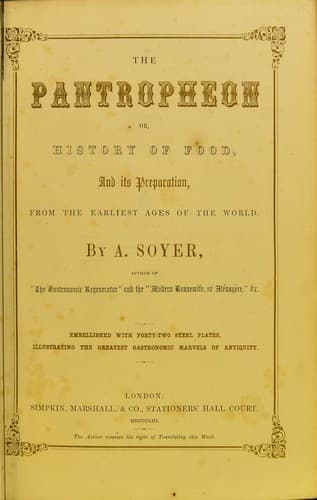
The Pantropheon; Or, History of Food, Its Preparation, from the Earliest Ages of the WorldSoyer, Alexis
History
The Pantropheon; Or, History of Food, Its Preparation, from the Earliest Ages of the World
Soyer, Alexis
Cooking; Food; Gastronomy
“Reason and experience have proved to us, that it is of public utility
to suppress the practice of mication for the sale of cattle, and that it
is more advisable to sell by weight than to trust to a game with the
fingers. We, therefore, ordain that, after the weight of the animal is
ascertained, the head, feet, and tallow, shall belong to the butcher who
has killed, prepared, and cut it up: this shall be his wages. The skin,
flesh, and entrails, shall belong to the master-butcher who is to retail
it. In this manner, the buyer and seller will know the weight of the
meat on sale, and each will find this method to his advantage. * * * We
will and decree that this ordinance be executed for ever, under pain of
death.”[XV-57]
There were at first, in Rome, two corporations or colleges of butchers:
one had to take care that the city was always sufficiently supplied with
oxen, calves, and sheep:[XV-58] the other was to provide that immense
capital with the quantity of hogs necessary;[XV-59] and it would be
difficult to form an idea of the number consumed by the Romans. Every
day a distribution was made to the people, by Valentinian’s order, of
24,086 pounds and eight ounces of pork; to this amount, already
considerable, must be added the truly prodigious daily sale; for the
entire population, from the highest to the lowest, were all passionately
fond of this kind of food.[XV-60]
The obligations and privileges of these two corporate bodies were nearly
the same as those of the bakers.[XV-61] The children could not, under
any pretext whatsoever, abandon the trade of their fathers, without
DESCRIPTION OF PLATE No. VIII.
SCALES AND WEIGHTS.--The ancients had several species of scales.
No. 1. A common scale, with two basins, and a movable weight, which
is made in the form of a head, covered with the pileus, because
Mercury had the weights and measures under his superintendence.
This ornamented scale is engraved on a stone in the gallery of
Florence.
No. 2. The Roman scale, beautifully made, with one tray, several
hooks, and the movable weight, in the shape of a shell.
No. 3. Common heavy weight.
No. 4. The Roman weights had the form of a sphere, partly cut above
and below; the greatest number of those which still subsist are of
basalt. The number of ounces, or of pounds, is commonly engraved on
the top, or inlaid with silver. All round it are inscriptions with
the name of the temple where they were preserved after they had
been stamped, together with the name of the prince, or the præfect
before whom the standard mark was made.
On No. 4, is “D. N. Honori. Aug. Domini nostri Honorii Augusti;”
and on No. 5, “Temp. Opis. Aug.,” or the temple of Opis Augusta.
[Illustration: _Pl. 8._]
Public-domain text, read in full here on John Shaqi.
Reviews
Reviews
No reviews yet
Be the first to share your thoughts on this work.
Elsewhere in the archive
Join the Discussion
Join the discussion
Sign in to leave a comment or review.
Sign InorCreate an account