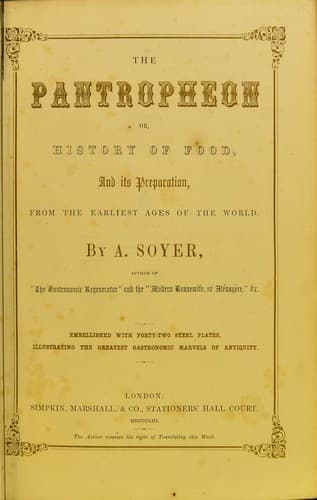
The Pantropheon; Or, History of Food, Its Preparation, from the Earliest Ages of the WorldSoyer, Alexis
History
The Pantropheon; Or, History of Food, Its Preparation, from the Earliest Ages of the World
Soyer, Alexis
Cooking; Food; Gastronomy
Hitherto the pig has only figured in a point of view purely historical;
we have not sought to weaken its faults, nor have we made mention of the
qualities attributed to it--for example, that of discovering truffles.
Nevertheless, we ought not to lose sight of the fact, that this animal
has not passed entirely without renown through the centuries which
divide us from the earliest ages of the world. We shall now speak of its
flesh, its exquisite flavour, and the place it occupied in feasts: there
it reigned with honour; there we must follow it, with all that antiquity
has possessed of celebrated men in the science of degustation and good
living.
Nature has created the pig for man’s palate; he is good only to be
eaten; and life appears to have been given to him merely as a sort of
salt to prevent his corrupting.[XVI-21] It is true that he possesses
only a vulgar and purely animal substance; but how good is this
substance, and how high does it deserve to be placed on account of its
delicacy and flavour?[XVI-22]
Such is the praise of which a physician and two philosophers have
thought it worthy.
The pig furnishes a strong and somewhat heavy kind of food;[XVI-23]
wherefore wrestlers were recommended to eat much of it, and Galen
advised it to persons who worked hard, or used violent exercise.[XVI-24]
But it was not necessary to recommend to the Greeks a meat of which they
were so fond. Look over the long work of Athenæus--he everywhere extols
it, everywhere speaks of it with fresh complacency, and in pompous
terms.[XVI-25]
An Athenian, renowned as a man of taste and for the refined elegance of
his table, would have thought his reputation lost had he not offered to
his guests fat _andouilles_, sausages, pigs’ feet, and pork cutlets;
above all, he was careful not to forget salted and smoked hams--the
honour of the banquet, and the delight of the human race.[XVI-26]
The Macedonian, Caranus, invited twenty of his best friends to his
wedding, and gave them a feast, of which gastrophagic annals have
preserved the remembrance. Each guest received from his munificence a
flagon and crown of silver, a crown of gold, and vases of the same
precious metal. What shall we say of the dishes displayed at this
meeting of learned epicureans? Composed by the art of the most skilful
cooks, struck with admiration, they ate and relished, whilst unexpected
wonders unceasingly solicited their fatigued, yet not satiated,
appetites; when at last appeared an immense silver dish, on which was
displayed an entire roasted hog, whose vast sides concealed a multitude
of quails and other small birds, _tétines de truie_, relishing yolks of
eggs, oysters, and a host of shell fish, prepared with that scientific
regard for gastric energy which considerably increases its
power.[XVI-27]
Public-domain text, read in full here on John Shaqi.
Reviews
Reviews
No reviews yet
Be the first to share your thoughts on this work.
Elsewhere in the archive
Join the Discussion
Join the discussion
Sign in to leave a comment or review.
Sign InorCreate an account