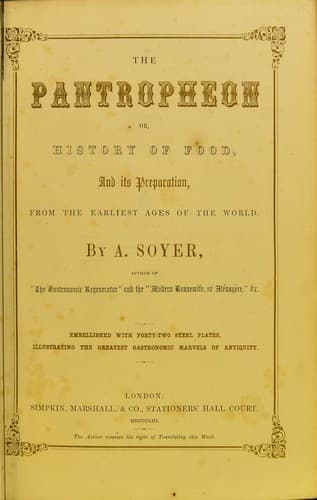
The Pantropheon; Or, History of Food, Its Preparation, from the Earliest Ages of the WorldSoyer, Alexis
History
The Pantropheon; Or, History of Food, Its Preparation, from the Earliest Ages of the World
Soyer, Alexis
Cooking; Food; Gastronomy
Westphalia supplied sumptuous tables with much-esteemed hams; but those
of Sardinia, Catalonia, and Cantabria were, nevertheless,
preferred.[XVI-40] They were sometimes served at the beginning of a
repast, in order to excite the appetite; and also often at the close, in
order to re-animate its extinguished ardour, and provoke new
libations.[XVI-41] One of the most ancient geoponics teaches how to
prepare, salt, and smoke hams;[XVI-42] for the inhabitants of the
country, and the lower classes in the cities, showed a singular taste
for this delicate meat, which the Gauls (great amateurs of
pork)[XVI-43] sent them at a low price, with an enormous quantity of
pickled pork, _andouillettes_, and sausages.[XVI-44]
This last preparation, very celebrated in Lucania,[XVI-45] served as a
means of livelihood to a great number of Roman women, who also employed
themselves in making excellent black puddings, in imitation of those
eaten in Greece.[XVI-46]
Bacon was then of great utility, as in the present day, though oil
superseded it in the concoction of a host of dishes. Bacon for a long
time served almost as the exclusive food of the Romans,[XVI-47] before
their unruly luxury had given it up to the soldiers and
proletarians.[XVI-48] It was also found in all public houses,[XVI-49]
where the populace habitually gorged themselves with pork,
vegetables,[XVI-50] and hot water.[XVI-51]
The ancients salted the pig, in order to preserve it; but Apicius taught
them a very simple process for the use of epicures, which advantageously
replaced common brine. You take middling-sized pieces of pork, cover
them entirely with a sort of paste, composed of salt, vinegar, and
honey, and place them in vessels which you close carefully.[XVI-52]
We will now indicate some of the dishes most in vogue prepared with
pork--a meat so much esteemed by the Greeks and Romans, and in which
they believed themselves to have discovered fifty different
flavours,[XVI-53] or fifty parts, each possessing a distinct taste from
the other.
_Apician Pork._--Roast a fine young sucking pig; and whilst a slow fire
gently embellishes it with a golden colour, pound, with pepper and
alisander, some coriander seed, mint, and rue. Then pour over it some
wine, honey, garum, or gravy; mix with care these different ingredients,
and pour this seasoning on your roast, as soon as you have taken it from
the spit or oven.[XVI-54]
Public-domain text, read in full here on John Shaqi.
Reviews
Reviews
No reviews yet
Be the first to share your thoughts on this work.
Elsewhere in the archive
Join the Discussion
Join the discussion
Sign in to leave a comment or review.
Sign InorCreate an account