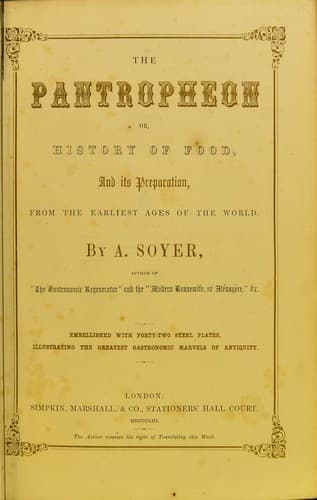
The Pantropheon; Or, History of Food, Its Preparation, from the Earliest Ages of the WorldSoyer, Alexis
History
The Pantropheon; Or, History of Food, Its Preparation, from the Earliest Ages of the World
Soyer, Alexis
Cooking; Food; Gastronomy
At a later period the Athenians decreed that their coins should bear the
image of this useful quadruped;[XVI-78] and though they then offered it
to their gods, the ceremonies even of the sacrifice testified the
repugnance felt at shedding its blood.
The sacrificer fled with the greatest speed after he had struck it; he
was followed, and, to avoid being arrested, he threw away the axe he had
used, and accused it of causing the death of the innocent ox. The axe
was then seized and tried; some one defended it, and alleged that it was
less guilty than the grinder who had sharpened the blade. The latter
cast the odium of the crime on the grinding stone, so that the trial was
never ended, and the pretended offence remained unpunished.[XVI-79]
For a long time the greater part of the ancients considered it a sin to
eat the flesh of the ox, the companion of the agriculturist, whose
patient vigour hollows the furrow which is to be the means of his
support.[XVI-80] But the bad example of Proserpine, who prepared one for
Hercules,[XVI-81] caused these scruples, one by one, to be hushed, the
solemn prohibition of the legislator of Athens forgotten;[XVI-82] and,
in spite of the obstinate resistance of the Pythagorians and the
disciples of Empedocles, every one declared in favour of the doctrines
of Zeno and Epicurus.
Moreover, it is certain that the heroes of Homer were not so scrupulous:
Menelaus offered roast-beef to Telemachus; Agamemnon also presented some
to the wise Nestor; and an ox, roasted whole, frequently appeased the
robust appetite of the illustrious chiefs of Greece.[XVI-83]
If we go back to centuries still more remote, and of which a venerable
historian has preserved us an account, we find herds of oxen were
possessed by the great patriarchal families.[X][XVI-84] Abraham cooked a
calf and served it to the three angels, in the valley of Mamre;[XVI-85]
and the flesh of this animal, whether ox or heifer, was evidently much
in use in the primitive ages, since no particular proscription exempts
them from those beings having “life and motion,”[XVI-86] and which are
to serve us as food.[XVI-87] As to Moses, far from interdicting it to
the Israelites, he places the ox in the first rank of pure
animals,[XVI-88] whose flesh was allowed them.
The oracle of ancient medicine, Hippocrates, praises the flesh of the
ox, in which he recognises the most nutritious qualities, but
nevertheless he believes it to be heavy and indigestible.[XVI-89]
Of what material, then, must have been the stomach of Theagenes, of
Thasos--he, who devoured a whole bull in one day.[XVI-90]
Public-domain text, read in full here on John Shaqi.
Reviews
Reviews
No reviews yet
Be the first to share your thoughts on this work.
Elsewhere in the archive
Join the Discussion
Join the discussion
Sign in to leave a comment or review.
Sign InorCreate an account