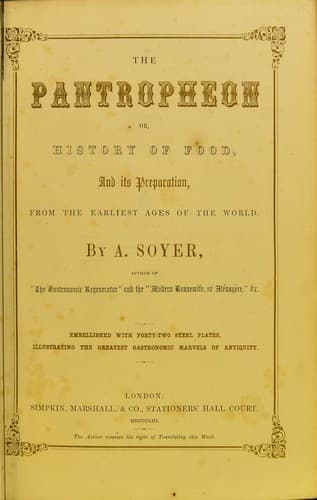
The Pantropheon; Or, History of Food, Its Preparation, from the Earliest Ages of the WorldSoyer, Alexis
History
The Pantropheon; Or, History of Food, Its Preparation, from the Earliest Ages of the World
Soyer, Alexis
Cooking; Food; Gastronomy
_Bœuf Gras._--There is a very old custom in the whole of France, and
which consists in leading throughout the streets, in the provincial
towns, on Shrove Tuesday, a fatted ox, ornamented with flowers and
ribbons. This ceremony is considered as a commemorative emblem of the
fecundity of the earth. In Paris, the ox chosen for the same purpose has
generally obtained beforehand the prize awarded by the Agricultural
Society. The horns of the animal are gilded; he is afterwards decorated
in a sumptuous manner, and led through the principal thoroughfares of
that city, on Shrove Sunday, Monday, and Tuesday, to the Palace of the
Tuileries, the ministerial residences, the Hôtel-de-Ville, and the
foreign embassies. Troops of butchers, dressed in appropriate fancy
costumes, both on horseback and on foot, are preceded by bands of
music; and the heathen divinities, drawn by eight horses in a richly
gilt triumphal car, form one of the most splendid and grotesque pageants
of modern times.
THE LAMB.
Formerly, sworn examiners of the clouds, skilful in discovering the
storms they concealed, announced to the inhabitants of the country the
hail by which their crops were threatened, and every one immediately
offered a sacrifice to the inimical cloud, in order that it might carry
ruin and desolation elsewhere. The most devout sacrificed a lamb; the
lukewarm worshippers a fowl; some even contented themselves with
pricking their finger with a pin, and throwing towards heaven the drops
of blood which came out. The cloud, it is said, satisfied with these
pious offerings, soon disappeared never to return.[XVI-110]
The lamb, an oblation pure and agreeable in the sight of the gods,
reconciled the earth with Olympus. In Egypt, the inhabitants of Sais and
Thebes offered it to their divinities.[XVI-111] Minerva and Juno also
were pleased to see its flesh smoking on the altars which Greece and
Italy raised to them.[XVI-112]
These practices, no doubt, were an obscure imitation of the religious
rites which Moses prescribed to his people,[XVI-113] and which heathen
nations adopted in their turn, one from the other.[XVI-114]
The Hebrew law forbad the killing of the Paschal lamb before it was
weaned, and also the cooking of it in its mother’s milk. It was to be
eaten roasted, with unleavened bread, lettuces, mustard, or bitter
herbs: whatever might remain was to be burnt with fire. It was not to be
boiled, nor a bone of it broken. It must be chosen of that year, a male,
and without fault or blemish.[XVI-115]
Many passages of the sacred writings allow us to appreciate the pastoral
riches of the first nations of the East; and an idea may be formed of
the number of their flocks, when we are told that Jacob gave the
children of Hamor a hundred sheep for the price of a field;[XVI-116] and
that the King of Israel received a hundred thousand every year from the
King of Moab, his tributary, and a like number of rams, covered with
their fleece.[XVI-117]
Public-domain text, read in full here on John Shaqi.
Reviews
Reviews
No reviews yet
Be the first to share your thoughts on this work.
Elsewhere in the archive
Join the Discussion
Join the discussion
Sign in to leave a comment or review.
Sign InorCreate an account