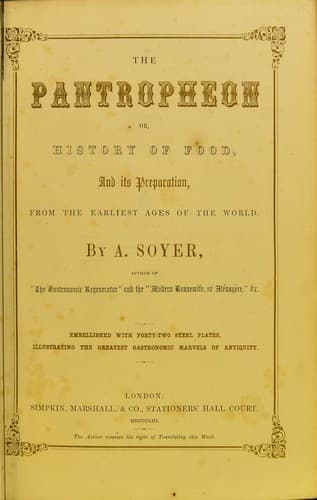
The Pantropheon; Or, History of Food, Its Preparation, from the Earliest Ages of the WorldSoyer, Alexis
History
The Pantropheon; Or, History of Food, Its Preparation, from the Earliest Ages of the World
Soyer, Alexis
Cooking; Food; Gastronomy
“At Kidlington, in Oxfordshire, the custom is, that on Monday after
Whitson week, there is a fat, live lamb provided, and the maids of the
town, having their thumbs tied behind them, run after it, and she that
with her mouth takes and holds the lamb is declared _Lady of the Lamb_,
which, being dressed, with the skin hanging on, is carried on a long
pole before the Lady and her companions to the Green, attended with
music, and a morisco dance of men and another of women, when the rest of
the day is spent in dancing, mirth, and merry glee. The next day the
lamb is part baked, boiled, and roast, for the Lady’s feast, where she
sits majestically at the upper end of the table, and her companions with
her, with music and other attendants, which ends the
solemnity.”[XVI-129]
THE KID.
The kid was one of the most delicate dishes of the Hebrews: Rebecca
prepared some for Isaac, in order to dispose him to give his blessing to
Jacob.[XVI-130] Moses ordered that, for the Feast of Passover, a lamb or
a kid should be slain.[XVI-131] Samson carried a kid to his young wife
when he wished to be reconciled to her.[XVI-132] The brother of the
prodigal son complains to his father that he has never given him a kid
to make merry with his friends.[XVI-133]
The Egyptians, who represented their god Pan with the face and legs of a
goat, abstained religiously from killing a kid or eating its
flesh.[XVI-134] Their veneration for this animal went so far, in some
countries, that goat-keepers appeared in their eyes invested with an
august and sacred character.[XVI-135] The Greeks did not judge it
convenient to adopt these strange ideas, although on other points their
theology was sufficiently ridiculous. The kid was considered one of the
most dainty dishes in state banquets; it was served whole, on a silver
basin, to each of the guests at the wedding of the Macedonian,
Caranus.[XVI-136]
The kids of Attica were especially praised, and a considerable trade
was made of them in Athens.[XVI-137] Certain connoisseurs, whose
authority had weight, preferred, however, those produced in the Island
of Mælos.[XVI-138] A great many also came from Sicily: they were in less
repute, and sold at a low price.[XVI-139]
At Rome, the kid of Italy was much thought of; the most delicate were
fattened at Tivoli,[XVI-140] and in different localities of the Roman
Campagna.[XVI-141]
_Kid à la Trans-Tibérienne._--The kid is to be cooked slowly, with a
little milk, four ounces of honey, an ounce of pepper, a little salt and
benzoin. After some time, add eight dates crushed in a mortar, a little
gravy, garum, a small quantity of excellent wine; the whole is thickened
with fine flour.[XVI-142]
_Roast Kid à la Janiculum._--Empty and carefully clean a kid; rub it
well with oil and pepper; sprinkle with salt and a large quantity of
coriander seed; place it in the oven, and bake slowly.[XVI-143]
Public-domain text, read in full here on John Shaqi.
Reviews
Reviews
No reviews yet
Be the first to share your thoughts on this work.
Elsewhere in the archive
Join the Discussion
Join the discussion
Sign in to leave a comment or review.
Sign InorCreate an account