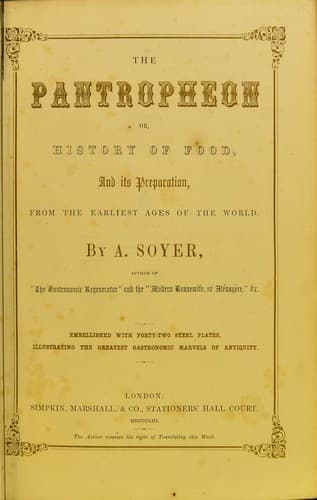
The Pantropheon; Or, History of Food, Its Preparation, from the Earliest Ages of the WorldSoyer, Alexis
History
The Pantropheon; Or, History of Food, Its Preparation, from the Earliest Ages of the World
Soyer, Alexis
Cooking; Food; Gastronomy
The learned Bochart denies this prodigy.[XX-28] He affirms that Hercules
was subject to epileptic attacks, and that, during a fit, they caused
him to smell a quail, whose odour quickly cured him.[XX-29]
The Phœnicians insisted that he was quite dead, and they all cried
out, “A miracle!”[XX-30] The reader must decide between them and
Bochart.
In the Desert the Israelites fed on quails;[XX-31] and this food,
reserved for them by Divine goodness, caused no discomfort among the
fugitive tribes. The Greeks served them on their tables with
partridges:[XX-32] they raised them in aviaries, and eat them all the
year round.[XX-33] Aristotle speaks most highly of them, and does not
attribute to them any dangerous property.[XX-34] However, quails were
banished from all Roman tables: they were no longer carefully
fattened:[XX-35] they were cursed, and accused of causing epilepsy in
those who partook of their fatal and seductive flesh.[XX-36] The
authority of Galen confirmed this strange prejudice,[XX-37] and these
innocent birds, having lost all reputation in Italy, no doubt easily
consoled themselves for the happy ostracism which delivered them from a
too expensive glory.
At all events, it is probable that Rome had wickedly calumniated quails;
two skilful men, devoted to the cause, undertook to defend them: they
were called Hippolochus and Antiphanus.[XX-38] Their eloquent pleadings
caused a sensation; the epicureans were moved, and some of these birds
were recalled, fattened, and roasted.
Quails, like cocks and partridges, seem born to fight to excess.[XX-39]
The Grecians encouraged their warlike ardour, and threw them into the
arena, where they contemplated their furious attacks with as much
pleasure as they experienced at the sight of gladiators murdering each
other in order to amuse them.[XX-40] Solon--the wise Solon--required
that young men should be trained to courage at the school of these bold
champions, and learn from them to despise danger, pain, and
death.[XX-41] We know that sensibility was little thought of in the plan
of education formed by the great legislator. Long after him, however,
the Areopagus gave a dreadful proof of this, by condemning to death a
little boy who had amused himself by pulling out the eyes of all the
quails unfortunate enough to fall into his hands. This precocious
monster was too promising.[XX-42]
THE THRUSH.
The immortal author of the Iliad did not disdain, it is said, to compose
a poem in praise of thrushes. These verses were so beautiful that the
Greeks learned them all by heart in their infancy.[XX-43] The singular
love of the ancients for this bird renders these poetical honours
tolerably probable. More than once Comus has borrowed the lyre of
Apollo.
Public-domain text, read in full here on John Shaqi.
Reviews
Reviews
No reviews yet
Be the first to share your thoughts on this work.
Elsewhere in the archive
Join the Discussion
Join the discussion
Sign in to leave a comment or review.
Sign InorCreate an account