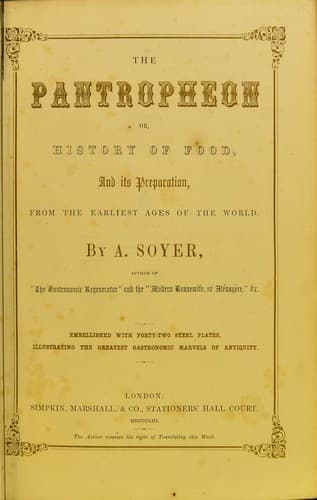
The Pantropheon; Or, History of Food, Its Preparation, from the Earliest Ages of the WorldSoyer, Alexis
History
The Pantropheon; Or, History of Food, Its Preparation, from the Earliest Ages of the World
Soyer, Alexis
Cooking; Food; Gastronomy
And yet some persons of culinary authority paid but little attention to
the flesh of this delicate fish; they sought only the liver and head;
and if they paid for it so dearly, it was solely to find some few
mouthfuls more in these two parts,[XXI-52] to which caprice, enthusiasm,
that fever of admiration, and we know not what extraordinary gastronomic
rage, gave an inestimable price, which at the present day excites only a
smile of incredulity.
Pliny speaks of a mullet caught in the red sea, which weighed eighty
pounds.[XXI-53] “At how much,” adds this great naturalist, “would it
have been valued had they caught it in the environs of Rome!” We may
suppose, without the least exaggeration, that many a senator would have
offered £1,500 to become its possessor.
It is thus that the mistress of the world foolishly dissipated in
ephemeral whims the immense treasures poured into her lap by tributary
kings--conquered and spoliated nations. Each day her patricians,
knights, and nobles, tired of their importunate opulence, solicited new
diversions, and invented new excesses. The mullet for a moment satisfied
their prodigality, and amused their barbarity; but Heliogabalus
appeared, and he imagined prodigies of gluttony which excited at once
admiration and envy. The liver of this fish appeared to him too paltry;
he took it into his head to be served with large dishes completely
filled with the gills.[XXI-54] Now, we know that the mullet possesses
only two. This dish, whose price would have enriched a hundred families,
was worthy of the Sardanapalus of Rome, who, at the age of eighteen, had
exhausted the treasures of the empire, and whom a violent death seized
most _à propos_, at the moment when he had attained the extreme limits
of crime and infamy.
The Romans served the mullet with a seasoning of pepper, rue, onions,
dates, and mustard, to which they added the flesh of the sea hedge-hog
reduced to a pulp, and oil.[XXI-55]
When the liver alone was to be eaten, it was cooked, and then seasoned
with pepper, salt, or a little garum--some oil was added, and hare’s or
fowl’s liver, and then oil was poured over the whole.[XXI-56]
The Greeks knew how to appreciate the mullet. They thought highly of
those caught on their own shores[XXI-57], and placed them in the first
rank of the most exquisite dishes of their delicate cookery.
“It is with the eggs of mullets, when salted, pressed, washed, and
dried, that the preparation known as _botargo_ or _botarcha_ is made. It
is very _recherché_ in Italy, and other southern countries, as a
seasoning.”--DR. CLOQUET.
SEA-EEL.
The sumptuous abode of L. Crassus echoes with his sighs and groans. His
children and slaves respect his profound sorrow, and leave him with
intelligent affection to solitude--that friend of great grief; so
grateful to the afflicted soul, because tears can flow unwitnessed.
Alas! the favourite sea-eel of Crassus is dead, and it is uncertain
whether Crassus can survive it!
Public-domain text, read in full here on John Shaqi.
Reviews
Reviews
No reviews yet
Be the first to share your thoughts on this work.
Elsewhere in the archive
Join the Discussion
Join the discussion
Sign in to leave a comment or review.
Sign InorCreate an account