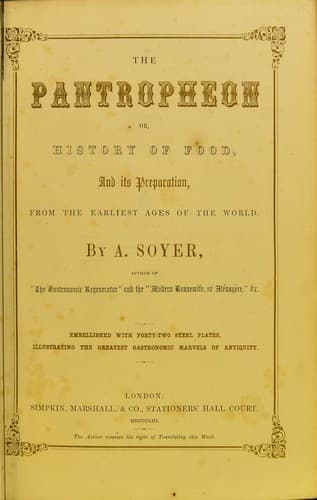
The Pantropheon; Or, History of Food, Its Preparation, from the Earliest Ages of the WorldSoyer, Alexis
History
The Pantropheon; Or, History of Food, Its Preparation, from the Earliest Ages of the World
Soyer, Alexis
Cooking; Food; Gastronomy
The diploma, or double-vase, which has sometimes been confounded with
the authepsa, does not in the least resemble the latter. It is thus they
named the vessel called by us a “_bain-marie_;”[XXII-66] the ancients
made great use of this mild and gentle process of cooking, which is
often mentioned in the treatise of Apicius.[XXII-67]
These brass boilers, which boil on the hearth, supported by three feet,
are precisely like those used by the French at the present day.[XXII-68]
Boilers also of a rather different kind are sometimes used, in which the
operation of ebullition takes place sooner than in the first mentioned;
they are closed with a cover in the form of a dome, and a large hollow
cylinder, fixed beneath, hastens and keeps up the action of the
caloric.[XXII-69]
The saucepans, around which a host of cooks are busily engaged, are for
the greater part made of brass or earthenware,[XXII-70] tolerably wide
and deep, which they place on the stoves, and in which are concocted the
delicate and scientific preparations. Some are of silver.[XXII-71] The
caprices of luxury have led them to suppose that certain expensive
viands acquire greater perfection when cooked in this precious metal.
A confidential slave, charged with the care of the plate, is cleaning
and polishing near a dresser a large number of bronze chafing-dishes,
which are to be used at table to prevent the plates from becoming cold.
It is in speaking of this useful invention that Seneca, the philosopher,
says, “Daintiness gave birth to this invention, in order that no viand
should be chilled, and that everything should be hot enough to please
the most pampered palate. The kitchen follows the supper.”[XXII-72] Each
of these elegant utensils is supported by three geese. It measures about
seven inches from the extremity of one of the bird’s heads to the
opposite edge of the circumference. This kind of tray is fifteen lines,
or an inch and a-quarter deep, and the feet raise it about two inches
above the plane. The three geese have their wings spread, and terminate
by
DESCRIPTION OF PLATE No. XIII.
No. 1. This boiler is made of bronze; the lower part was filled
with water, and made to boil by means of the cylinder, covered with
a lid, in which lighted charcoal was introduced; the ashes escaped
through holes perforated at the bottom, and the basin has a tap to
let the water out.
No. 2. A flat saucepan, or sauté pan, with a fluted handle, and a
ram’s head at the end.
No. 3. A kettle similar to our teapots.
No. 4. A gridiron, and a dripping-pan.
No. 5. A trivet, a cleaver, and a butcher’s knife.--ST. NON,
“_Cabinet of Herculaneum_.”
[Illustration: _Pl. 13._]
[Illustration: _Pl. 14_]
neats’ feet. The heads, raised on the breasts, form graceful
handles.[XXII-73] These chafing-dishes, arranged systematically on the
sigma, produce a delightful effect.
Public-domain text, read in full here on John Shaqi.
Reviews
Reviews
No reviews yet
Be the first to share your thoughts on this work.
Elsewhere in the archive
Join the Discussion
Join the discussion
Sign in to leave a comment or review.
Sign InorCreate an account