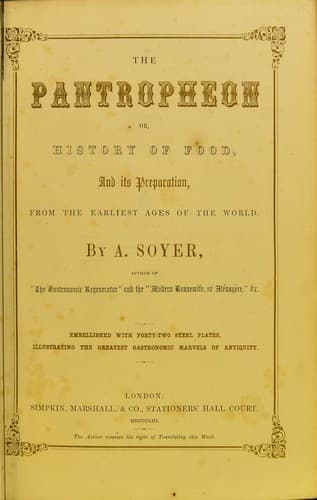
The Pantropheon; Or, History of Food, Its Preparation, from the Earliest Ages of the WorldSoyer, Alexis
History
The Pantropheon; Or, History of Food, Its Preparation, from the Earliest Ages of the World
Soyer, Alexis
Cooking; Food; Gastronomy
The knives, destined to serve at table, are of brilliant steel, and
carefully sharpened; they bear each on the handle some whimsical
ornament, and seem to have served as models for those which were so much
in fashion towards the beginning of the 17th century, and which were
called Chinese knives.[XXII-85]
The most precious plate is arranged before the arrival of the guests on
the abacus, or sideboard, which decorates the dining room. This splendid
piece of furniture, which will be noticed hereafter, was introduced into
Rome 187 years B.C. It was also called the Delphic table.[XXII-86]
However, the _Archimagirus_ has drawn up a list of the repast, which
contains the bill of fare of the dishes, and which, both in Greece and
Rome, was always presented to the guests.[XXII-87] He descends from his
platform, and goes to cast an inspiring glance on the work of each
subordinate. Nothing escapes his learned investigation, from the
peacocks’ eggs of the first service, to the soft cheese commonly eaten
at the third.[XXII-88] Above all, he examines with minute attention the
ovens, at which preside those second cooks of whose talents he is not
certain, and who belong to that class of erratic artists who are to be
met with every day at the forum,
DESCRIPTION OF PLATE No. XV.
No. 1. Roman silver spoon, found at Autun, in France. Martial says
expressly that spoons were used by the ancients to eat eggs and
shell fish.
No. 2. Brass knife, from Herculaneum. The shape of the handle is
rather singular, being too small for the hand, but it was probably
covered with horn, wood, or ivory. However, it may have been, the
knife is thirteen inches in length, from the tip to the ring, which
was used to hang it up. The handle is three inches long, and the
blade in its largest width is one inch and a quarter. It was used
no doubt for sacrifices.
No. 3. A simpulum, or a sort of spoon for salt or eggs.
No. 4. A simpulum, or cup with a long handle, commonly ending with
a hook, which was used as a ladle to take wine or other liquids out
of large vessels.
No. 5. Fork mentioned in the text, and given as antique in the
“_Recueil d’Antiq.,_” III., Pl. 84.
[Illustration: _Pl. 15._]
[Illustration: _Pl. 16_]
Public-domain text, read in full here on John Shaqi.
Reviews
Reviews
No reviews yet
Be the first to share your thoughts on this work.
Elsewhere in the archive
Join the Discussion
Join the discussion
Sign in to leave a comment or review.
Sign InorCreate an account