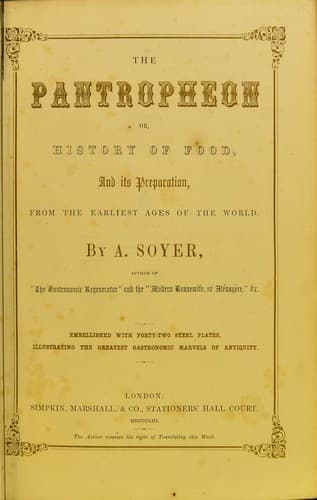
The Pantropheon; Or, History of Food, Its Preparation, from the Earliest Ages of the WorldSoyer, Alexis
History
The Pantropheon; Or, History of Food, Its Preparation, from the Earliest Ages of the World
Soyer, Alexis
Cooking; Food; Gastronomy
It is not necessary here to give our private recipe to prepare an
infusion in which that excellent lady, _Madame Pochet_, thought herself
so perfect; suffice to say, that to make it agreeable to her guests she
added salt, pepper, some cinnamon, the yolk of an egg, and a tiny drop
of vinegar. We would beg the reader not to fail in attending these
charming and daily meetings, at which each housewife presides, and we
would say to strangers, let us seriously study an English tea.
“The use of tea in China dates from the greatest antiquity. The Japanese
attribute to it a miraculous origin. They say that Darma, a very pious
prince, and son of an Indian king, landed in China in the year 510 of
the Christian era, and wishing to edify mankind by his example, imposed
upon himself privations of all kinds. It happened, however, that after
several years of great fatigue, in spite of his care he fell asleep; and
believing he had violated his oath, and in order to fulfil it faithfully
for the future, he cut off his eyelids and threw them on the ground. The
next day, returning towards the same spot, he found them changed into a
little shrub, hitherto unknown to the earth. He eat some of the leaves,
which made him merry and restored his former strength. Having
recommended the same food to his disciples, the reputation of tea soon
spread, and has continued in use since that time.”--DESFONTAINES. See,
also, KŒMPFER, in his “_Aménités Exotiques_.”
We are ignorant of the period and motives which persuaded the Chinese to
use tea in infusion. Perhaps it was to render water more agreeable,
which is said to be brackish and of a bad taste in many parts of China.
In 1641, Tulpius, a Dutch physician, was the first to mention this
plant, in a dissertation he published. In 1657, Joncquet, a French
physician, called it the divine plant, and compared it to ambrosia. In
1679, Cornelius Bentekoe, a Dutch physician, published a treatise, in
which he declared himself a partisan of tea, and asserted that this
beverage in no way could injure the stomach, even if drank to the extent
of _two hundred cups_ a day. Many of his countrymen went even beyond
this: they made of it a universal panacea.
As at first the leaves of the tea plant were rare and but little known,
many persons thought they had discovered in Europe what others fetched
from such a distance. Thus Simon Pauli introduced the royal pimento
(_myria gale_ of LINN.), as the real tea of China. Others thought to
have found the marvellous virtues of tea in plants growing in our own
country, such as marjoram, veronica, myrtle, sage, agrimony, &c.; but it
happily ended in granting the preference to the real tea of China and
Japan.
COFFEE.
In the trade five principal kinds of coffee are enumerated--or rather,
five sorts--according to the different countries from whence they come,
although all derived from the same kind of coffee tree, _Coffea
Arabica_. These five kinds are as follows:--
Public-domain text, read in full here on John Shaqi.
Reviews
Reviews
No reviews yet
Be the first to share your thoughts on this work.
Elsewhere in the archive
Join the Discussion
Join the discussion
Sign in to leave a comment or review.
Sign InorCreate an account