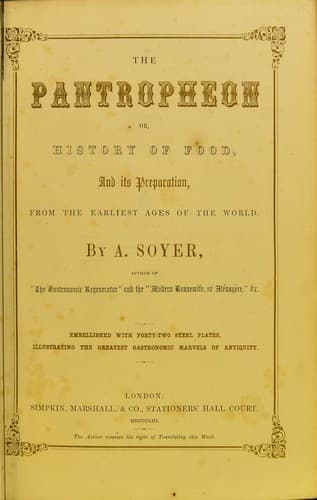
The Pantropheon; Or, History of Food, Its Preparation, from the Earliest Ages of the WorldSoyer, Alexis
History
The Pantropheon; Or, History of Food, Its Preparation, from the Earliest Ages of the World
Soyer, Alexis
Cooking; Food; Gastronomy
From Spain the fashion of taking chocolate was introduced into Italy,
especially by the Florentine, Antonio Carletti. The Italians extract
from cocoa more exalted qualities by torrefication: they burn it till it
becomes bitter. The grave question arose among them, whether chocolate
taken in the morning by the monks broke the fast principally in Lent.
The Cardinal Brancaccio, and other learned casuists, battled long in
order to prove that chocolate, being evidently a beverage made of water,
could not be in the least considered as an aliment, nor break the fast.
We see, indeed, in the correspondence of the Princess des Ursins--all
powerful at the court of Philip V. of Spain--and Madame de Maintenon,
that the consciences of pious persons had been placed in full
tranquillity by this decision, and that any one might fast during the
whole Lent as perfectly by drinking chocolate as if he had only partaken
of a glass of cold water.
“Chocolate became pretty common in France from the time of Anne of
Austria, mother of Louis XIV.; however, it does not appear to have ever
excited the same enthusiasm as coffee; it is not favourable to good
cheer, nor is it exhilarating. To this may be traced, perhaps, the
indifference of the English for this beverage.”--VIREY.
In trade, as we have said, are distinguished a great variety of cocoas,
and they are called by the name of the country whence they come. Thus we
have the Caracas cocoa, the Surinam cocoa, &c. That which comes from the
French possessions is called also “cocoa of the isles.” The Caracas is
the most esteemed of all: it is more oily than the other kinds, and has
no sharpness of flavour. It is known by being larger, rough, of an
ovoid, oblong shape, not flattened, covered with a greyish dust, and by
the kernel being easily divided into several irregular fragments. “The
name of _cacao_, of which in French has been made the word _cacaoyer_,
is that given by the inhabitants of Guiana to this grain. As to the
scientific name, _theobroma_, Linnæus formed it from two Greek words,
signifying ‘food of the gods.’ ”--DEMEZIL.
XXVII.
DRINKING CUPS.
If men were wiser, the 19th century would probably not have seen a
beneficent apostle preaching temperance everywhere, and making his name
cherished and celebrated by a series of successes which could hardly
have been expected; numerous societies of _Hydropotes_, or
“teetotallers,” would not alarm, in our days, those joyful disciples of
Bacchus’s temple, hydrophobes by profession, by taste, and interest, who
sincerely bewail the desertion of newly made abstemious members; and no
person would promise, by a solemn and formidable pledge, to forego the
drinking of anything but water! The abuse must have been very great,
since it was necessary to have recourse to such a remedy.
Public-domain text, read in full here on John Shaqi.
Reviews
Reviews
No reviews yet
Be the first to share your thoughts on this work.
Elsewhere in the archive
Join the Discussion
Join the discussion
Sign in to leave a comment or review.
Sign InorCreate an account